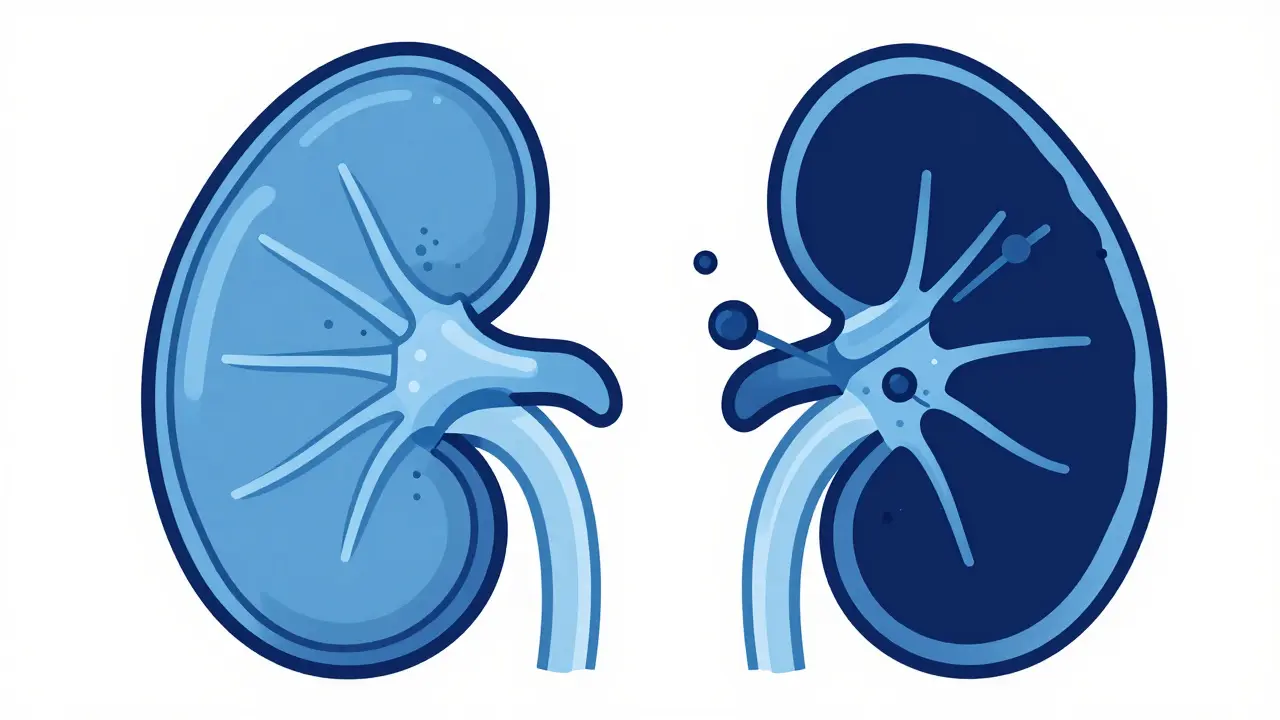
Understanding Acute Interstitial Nephritis
Your kidneys are hardworking filters that clean your blood every day. But sometimes, they get inflamed and stop working properly. This condition is called Acute Interstitial Nephritis (AIN), which is a sudden inflammation of the kidney's filtering tubes and surrounding tissue. It’s not a disease you catch like a cold; it’s usually a reaction to something inside your body, most often a medication you’ve been taking.
Think of it as an allergic reaction, but instead of breaking out in hives on your skin, your immune system attacks your kidneys. This causes swelling (edema) and blocks the tiny tubes that process urine. If left untreated, this can lead to acute kidney injury (AKI), where your kidneys suddenly fail to filter waste from your blood. The good news? AIN is often reversible if caught early. The bad news? It’s notoriously difficult to spot because its symptoms mimic common illnesses like the flu or a urinary tract infection.
The Hidden Culprits: Drugs That Trigger AIN
You might be surprised to learn that over 250 different medications have been linked to AIN. In fact, drugs cause about 60-70% of all cases. While antibiotics were historically the main suspects, the landscape has shifted. Today, three major classes of drugs stand out as the primary triggers:
- Proton Pump Inhibitors (PPIs): These acid-reducing drugs (like omeprazole or pantoprazole) are now the second most common cause. They account for nearly 38% of recent cases. What makes them tricky is that they often cause less severe initial symptoms, leading to delayed diagnosis and poorer recovery rates compared to other drugs.
- Non-Steroidal Anti-Inflammatory Drugs (NSAIDs): Common painkillers like ibuprofen, naproxen, and diclofenac cause about 44% of drug-induced AIN. These typically affect older adults (over 50) who have been using them chronically for arthritis or back pain. NSAID-induced AIN often presents with heavy protein leakage in the urine but fewer classic allergy signs like rashes.
- Antibiotics: Penicillins, cephalosporins, sulfonamides, and ciprofloxacin still play a significant role, causing about 33% of cases. Antibiotic-induced AIN tends to appear faster-often within 10 days of starting the drug-and is more likely to show the classic "hypersensitivity triad" of fever, rash, and high eosinophil counts.
It’s important to note that the risk isn’t just about taking one drug. Polypharmacy-taking five or more medications simultaneously-increases your risk by 3.2 times. Additionally, age matters. People over 65 face a significantly higher incidence rate (22 cases per 100,000) compared to younger adults (5 cases per 100,000).
Symptoms: Why AIN Is Often Missed
If you’re waiting for a dramatic symptom like visible blood in your urine or severe flank pain, you might miss the warning signs entirely. Only about 10% of patients experience the classic triad of fever, rash, and eosinophilia (high white blood cell count). Most people feel generally unwell.
Common early signs include:
- Fatigue and malaise (feeling washed out)
- Nausea or loss of appetite
- Mild fever or low-grade chills
- Joint pain (arthralgia)
- Decreased urine output (oliguria)
Because these symptoms overlap so much with viral infections or UTIs, many patients wait 2-4 weeks before getting a correct diagnosis. By then, the inflammation may have already caused some permanent damage. One patient story from the American Kidney Fund highlights this delay: a 63-year-old woman took omeprazole for heartburn for 18 months. She developed fatigue and nausea, was misdiagnosed with a stomach bug, and eventually required three weeks of dialysis before her kidneys began to recover.
Diagnosis: Beyond the Blood Test
When doctors suspect AIN, they start with basic blood tests to check creatinine levels (a marker of kidney function) and look for eosinophils in the blood. However, these tests aren’t definitive. Urine tests might show white blood cells or protein, but again, this isn’t unique to AIN.
The gold standard for diagnosis remains a kidney biopsy, which involves removing a small sample of kidney tissue to examine under a microscope for signs of inflammation, edema, and immune cell infiltration. While invasive, a biopsy provides crucial information about the severity of the damage and helps rule out other conditions like glomerulonephritis.
Newer research is exploring non-invasive biomarkers. For instance, a 2022 study at the University of North Carolina found that measuring urinary CD163 levels could detect AIN with 89% sensitivity. While this test isn’t yet widely available in clinical practice, it represents hope for earlier detection without surgery.
| Drug Class | Typical Onset | Key Symptoms | Recovery Rate |
|---|---|---|---|
| Antibiotics | Short (median 10 days) | Fever, rash, eosinophilia | High (70-80%) |
| NSAIDs | Long (median 12 months) | Heavy proteinuria, less rash | Lowest (highest CKD risk) |
| PPIs | Variable (weeks to years) | Mild symptoms, subtle labs | Moderate (50-60%) |
Treatment: Stopping the Trigger
The single most important step in treating AIN is stopping the offending drug immediately. Guidelines recommend discontinuing the suspected agent within 24-48 hours of suspicion. In many cases, simply removing the trigger allows the kidneys to heal on their own.
However, if kidney function doesn’t improve within 72 hours of stopping the drug, or if the injury is severe (eGFR <30 mL/min/1.73m²), doctors may prescribe corticosteroids. Drugs like prednisone or methylprednisolone help reduce inflammation quickly. A typical regimen might involve 0.5-1 mg/kg/day for 2-4 weeks, followed by a slow taper over 6-8 weeks. While large randomized trials haven’t definitively proven steroid efficacy, expert consensus suggests they improve outcomes when started early.
In severe cases where kidneys fail completely, temporary dialysis may be needed. About 15-20% of patients require dialysis for 2-6 weeks while their kidneys recover. This is not permanent failure; it’s a bridge to give the organs time to heal.
Recovery and Long-Term Outlook
How well you recover depends heavily on how quickly the diagnosis was made and which drug caused the problem. Here’s what the data shows:
- Antibiotic-induced AIN: Median recovery time is 14 days. Most patients regain full or near-full function.
- NSAID-induced AIN: Median recovery takes 28 days. This type has the highest risk of progressing to chronic kidney disease (CKD), with 42% of patients developing Stage 3+ CKD within a year.
- PPI-induced AIN: Median recovery takes 35 days. Only 50-60% achieve complete renal recovery.
Early diagnosis is critical. Patients diagnosed within 7 days of symptom onset have a 35% higher chance of complete recovery compared to those diagnosed after two weeks. Even with successful treatment, about 30% of AIN survivors develop some degree of chronic kidney impairment. Regular monitoring of blood pressure, kidney function (eGFR), and urine protein is essential for long-term health.
Prevention and Next Steps
Can you prevent AIN? Not entirely, since it’s an unpredictable immune response. However, you can reduce your risk by:
- Avoiding unnecessary long-term use of PPIs or NSAIDs.
- Informing all healthcare providers about every medication and supplement you take.
- Reporting any new rashes, fevers, or changes in urine output promptly.
- Requesting regular kidney function tests if you’re on long-term medication regimens.
If you suspect you have AIN, don’t wait. Contact your doctor immediately. Early intervention saves kidney function.
What is the most common cause of Acute Interstitial Nephritis?
Medications are the leading cause, accounting for 60-70% of cases. Specifically, Proton Pump Inhibitors (PPIs), NSAIDs, and certain antibiotics are the most frequent triggers. Among these, PPIs have become increasingly common in recent years.
How long does it take to recover from AIN?
Recovery time varies by drug type. Antibiotic-induced AIN often resolves in about 14 days, NSAID-induced in 28 days, and PPI-induced in 35 days. Complete recovery is possible, but some patients may retain mild kidney dysfunction.
Does AIN always require a kidney biopsy?
Not always, but a biopsy is considered the gold standard for definitive diagnosis. Doctors may diagnose based on clinical history and lab results first, especially if symptoms improve quickly after stopping the suspected drug. Biopsies are used when the diagnosis is unclear or if there is no improvement.
Can AIN lead to permanent kidney damage?
Yes. Approximately 30% of patients develop chronic kidney disease (Stage 3 or higher) within 12 months. NSAID-induced AIN carries the highest risk of permanent damage. Early diagnosis and treatment significantly reduce this risk.
Are there natural remedies for AIN?
There are no proven natural cures for AIN. The cornerstone of treatment is medical: stopping the causative drug and potentially using corticosteroids. Supportive care includes staying hydrated and managing blood pressure, but herbal supplements should be avoided as they may further stress the kidneys.