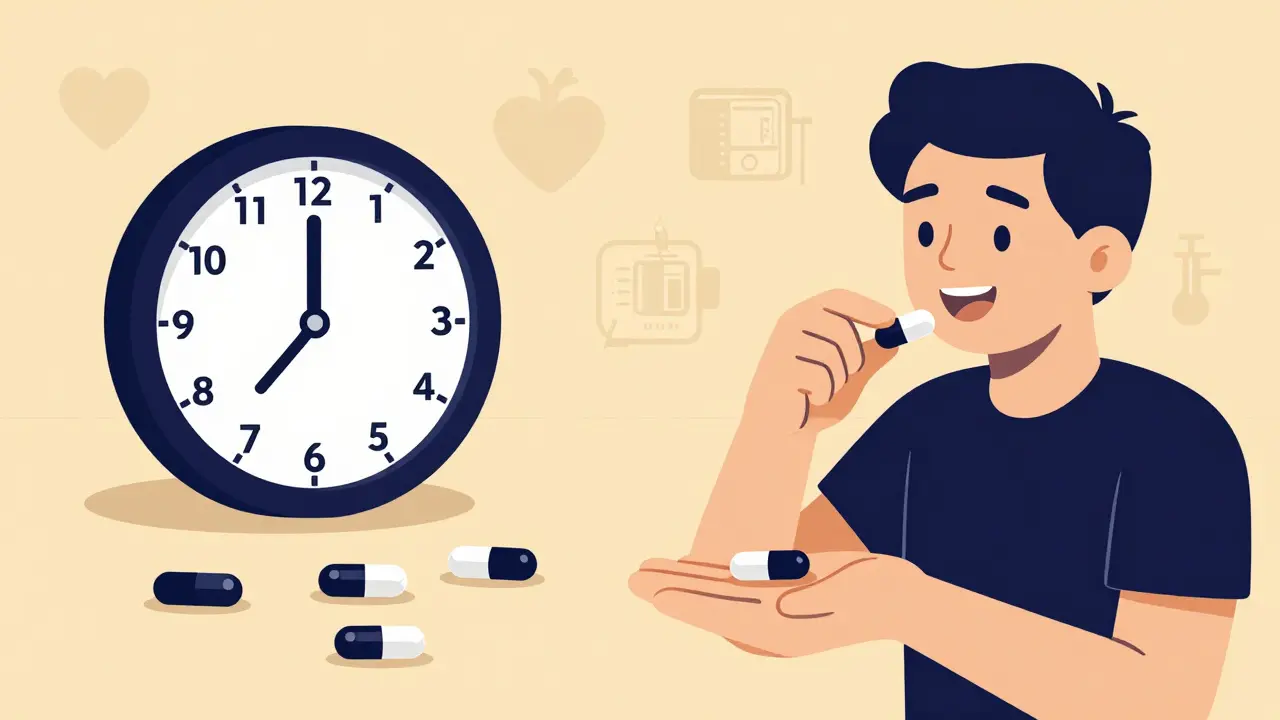
Imagine taking five different pills every morning just to manage your blood pressure, diabetes, and cholesterol. Now imagine taking just one. That’s the whole point of fixed-dose combination drugs - or FDCs. They’re not magic. They’re not just a way for drug companies to sell more pills. They’re a practical solution to a very real problem: people forget to take their meds. And when they forget, their health suffers.
What exactly is a fixed-dose combination drug?
A fixed-dose combination drug is exactly what it sounds like: two or more active medicines packed into a single pill or capsule. The doses don’t change. If you take one pill, you get 10 mg of Drug A and 5 mg of Drug B - always. You can’t take half a pill to get less of one ingredient. You can’t swap out one drug for another. The combination is locked in.
This isn’t new. The first big push for FDCs came in the 1990s with HIV treatment. Back then, patients had to take up to 20 pills a day. Many couldn’t keep up. Then came the first triple-combination antiretroviral pills. Suddenly, adherence jumped. Deaths dropped. That’s when the world realized: simplicity saves lives.
Today, the World Health Organization lists over 30 fixed-dose combinations as essential medicines. These include combinations like rifampicin and isoniazid for tuberculosis, sulfamethoxazole and trimethoprim for urinary infections, and levodopa with carbidopa for Parkinson’s. Each one was chosen because the drugs work better together - and because patients actually take them.
Why do FDCs even exist?
There are three big reasons: better results, fewer pills, and fewer mistakes.
First, some drugs just work better together. Take blood pressure. One drug might relax your arteries. Another might help your kidneys flush out extra fluid. Together, they lower pressure more effectively than either alone. That’s synergy. It’s not just adding numbers - it’s making the whole system work smoother.
Second, fewer pills mean fewer chances to forget. A 2020 study found that patients on FDCs were 20% to 30% more likely to stick to their treatment than those taking the same drugs as separate pills. That’s huge. In chronic diseases like diabetes or heart failure, missing a dose isn’t just inconvenient - it can lead to hospital visits, strokes, or worse.
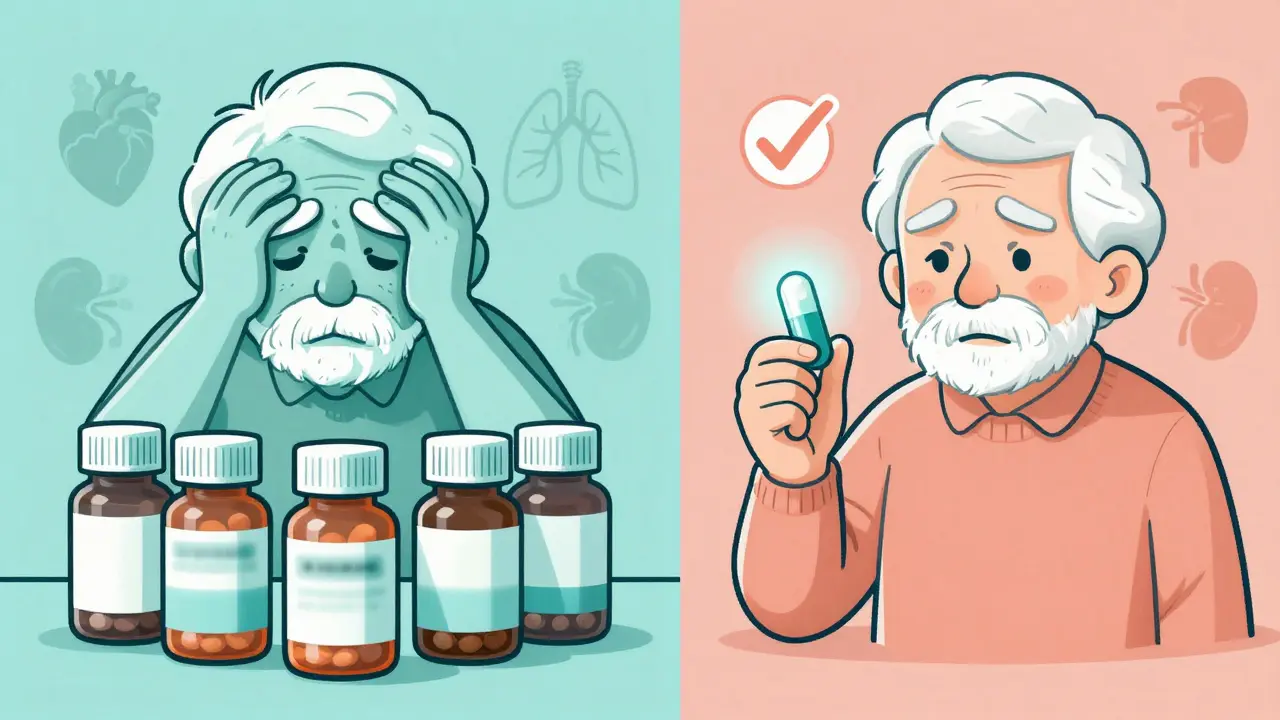
Third, FDCs reduce errors. Imagine a 75-year-old with arthritis trying to sort through six different pill bottles. One pill looks like another. The labels blur. The wrong pill goes in the mouth. FDCs cut that risk. One pill. One routine. One less thing to mess up.
But are FDCs always a good idea?
No. And that’s the catch.
Not every combination makes sense. Some FDCs are created because one drug’s patent is about to expire. The company slaps it with a newer, still-patented drug, packages them together, and calls it a “breakthrough.” Payers see right through it. They call it “lifecycle extension” - not therapy improvement.
The World Health Organization has strict rules for when FDCs should be used:
- The drugs must act through different mechanisms.
- Their effects in the body (pharmacokinetics) should match - no point combining a drug that lasts 8 hours with one that lasts 24.
- The combination shouldn’t make side effects worse than the sum of the parts.
When those rules are ignored, bad things happen. A patient gets a pill with a dose of Drug A that’s too high for them, but they can’t reduce it without losing Drug B. Or they develop a rash from Drug B, but can’t stop it because Drug A is still needed. That’s why regulators like the FDA and EMA require proof that each ingredient in the combo actually contributes to the benefit.
How are FDCs approved?
Getting an FDC approved isn’t easy - and it shouldn’t be.
If both drugs are already on the market, companies often use the FDA’s 505(b)(2) pathway. That means they don’t have to start from scratch with full safety trials. But they still have to prove the combo works better - or at least just as well - than the separate pills. They must show the body absorbs both drugs the same way in the pill as it does when taken alone.
And here’s the kicker: even if the drugs are old, the combo still needs clinical testing. Between 2010 and 2015, half of all approved FDCs still required full Phase 2 and 3 trials. That’s because regulators won’t accept convenience alone as proof of benefit. You need data.
Companies that skip this step - or make combos with no real clinical edge - get called out. In South Africa, for example, several FDCs for hypertension were pulled from the market after studies showed they offered no advantage over taking the drugs separately. The same happened in parts of Europe and the U.S.
Where are FDCs most common?
You’ll find them most often where multiple drugs are needed long-term.
Cardiovascular disease is the biggest category. Think: blood pressure + cholesterol + blood thinner. Dermatology too - acne creams with antibiotics and retinoids, eczema treatments with steroids and moisturizers. Then there’s HIV, TB, and Parkinson’s - all areas where adherence is life-or-death.
But the next big wave? Oncology and neurodegenerative diseases. Imagine one pill for Alzheimer’s that targets both amyloid plaques and inflammation. Or a cancer combo that hits two pathways at once, with fewer side effects. These are still experimental, but the research is moving fast.

What’s the downside?
Let’s be honest - FDCs aren’t perfect.
- You can’t adjust doses. If your kidney function drops and you need less of one drug, you’re stuck.
- Side effects are harder to trace. If you get dizzy, is it from Drug A or Drug B? You can’t test one without the other.
- Cost isn’t always lower. Sometimes the combo pill costs more than buying the two drugs separately - especially if it’s branded.
- Some patients hate the idea of “forced” combinations. They want control over what they take.
And then there’s the stigma. Some doctors worry FDCs are used more for profit than for patients. That’s why the best ones - the ones that actually help - come with strong evidence, not just marketing.
What should you look for?
If you’re prescribed an FDC, ask:
- Why this combo? Is there proof it’s better than taking the drugs separately?
- Can I get the same result with two pills? If so, why choose this one?
- What if I need to change one dose later? Is that possible?
- Is this on the WHO Essential Medicines List? That’s a good sign.
Don’t assume it’s better just because it’s one pill. But don’t dismiss it either. For millions of people, FDCs are the difference between staying healthy and ending up in the hospital.
What’s next?
The future of FDCs isn’t about more pills - it’s about smarter ones.
Researchers are working on combinations that adapt to how your body responds. Imagine a pill that releases one drug slowly and another quickly, based on your metabolism. Or smart packaging that tracks when you take it and sends a reminder if you skip a dose.
Regulators are getting tougher. Payers are demanding proof of real outcomes, not just convenience. And patients? They’re asking more questions.
The goal isn’t to replace single drugs. It’s to make combinations that truly improve life - without adding risk, cost, or confusion.
Fixed-dose combinations aren’t the answer to every problem. But for the right person, at the right time, one pill really can change everything.
Are fixed-dose combination drugs safe?
Yes, when they’re properly developed and prescribed. Regulatory agencies like the FDA and WHO require proof that each drug in the combination contributes to the benefit and doesn’t increase harm. But not all FDCs meet this standard. Some are approved for business reasons, not medical ones. Always ask your doctor or pharmacist why this specific combo was chosen for you.
Can I split a fixed-dose combination pill?
Never split an FDC unless your doctor or pharmacist says it’s safe. Many pills are coated or designed to release medicine slowly. Splitting them can change how the drugs are absorbed - and make them less effective or even dangerous. If you need a different dose, talk to your provider about switching to separate pills or a different combination.
Why do some FDCs cost more than buying the drugs separately?
Sometimes, it’s because the combo is still under patent, and the brand-name version is expensive. Other times, it’s because the manufacturer bundled the drugs and priced the pill based on the newer, still-patented component. In some cases, the cost is higher, but the savings come from fewer pharmacy visits, lower copays, and fewer missed doses - which reduce hospital visits later. Always compare prices and ask about generic options.
Do FDCs work better than taking the drugs separately?
It depends. For some conditions - like HIV, tuberculosis, or high blood pressure - FDCs have been shown to improve adherence and outcomes. For others, the difference is minimal. The key is whether the combination provides a real clinical advantage: better control, fewer side effects, or easier use. If it doesn’t, then taking the drugs separately is just as good - and often cheaper.
How do I know if my FDC is on the WHO Essential Medicines List?
You can check the latest WHO Model List of Essential Medicines online through their official website. The list includes only combinations that meet strict criteria for effectiveness, safety, and public health impact. If your medication is on the list, it means it’s been reviewed and endorsed by global health experts as a core treatment for a major condition. Ask your pharmacist or doctor to confirm if your FDC is listed.


Comments (12)