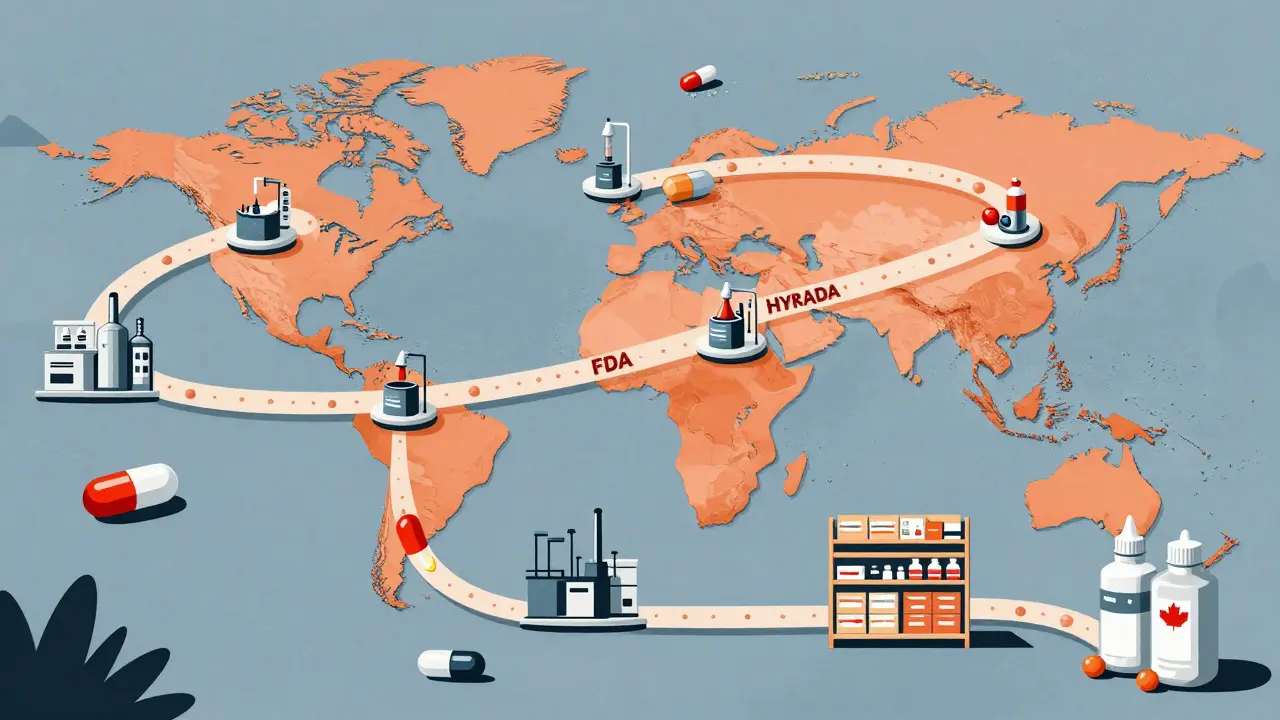
Have you ever wondered how a $4 bottle of generic atorvastatin ends up on your pharmacy shelf? It doesn’t just appear. Behind every generic pill is a global network of factories, regulators, wholesalers, and middlemen - all working to deliver affordable medicine to your hands. The system is efficient, but it’s also fragile, opaque, and under serious pressure.
Where It All Begins: The Active Pharmaceutical Ingredient
Every generic drug starts with an Active Pharmaceutical Ingredient, or API. This is the chemical that actually does the work - the thing that lowers your blood pressure or fights your infection. But here’s the twist: less than 12% of API manufacturing happens in the United States. Over 88% is done overseas, mostly in India and China. These countries have the infrastructure, lower labor costs, and regulatory frameworks that make large-scale production possible. A single batch of API might be made in a facility in Hyderabad, shipped to a packaging plant in Singapore, then flown to a warehouse in New Jersey. The problem? Quality control becomes a nightmare. The FDA inspects foreign facilities more than ever - 641 inspections in 2022, up from just 248 in 2010. But inspectors can’t be everywhere. And when a factory gets shut down for violating Good Manufacturing Practices (GMP), hundreds of drugs vanish from shelves overnight. During the pandemic, 170 generic medications faced shortages because one API plant in China went offline. That’s not an exception - it’s the rule.Getting Approved: The ANDA Process
You can’t just make a copy of a brand-name drug and sell it. The FDA requires every generic to go through the Abbreviated New Drug Application (ANDA) process. This means the manufacturer must prove their version is chemically identical and works the same way in the body as the original. No need to repeat expensive clinical trials - that’s why generics are cheaper. But the paperwork alone can take years. And once approved, the manufacturer has to stick to strict standards: batch testing, environmental controls, equipment calibration. One small deviation, and the whole lot gets thrown out. This is where the race to the bottom begins. Generic drugmakers operate on razor-thin margins. They compete not on quality, but on price. The company that can produce the most API with the least overhead wins. That means cutting corners on staffing, maintenance, or even testing. It’s not always intentional - sometimes, it’s just survival.From Factory to Wholesaler: The Middlemen Layer
Once the pills are made, they don’t go straight to CVS or Walgreens. They go to wholesale distributors - companies like McKesson, AmerisourceBergen, and Cardinal Health. These distributors buy in bulk, store millions of pills, and then sell them to pharmacies. But here’s the catch: the price you see on the invoice isn’t the real price. Wholesalers offer “prompt payment discounts” - if a pharmacy pays within 10 days, they get a 2% or 3% break. That sounds fair, right? But many small pharmacies can’t afford to pay upfront. So they take longer, pay more, and lose money on every transaction. Meanwhile, the wholesaler marks up the price to cover storage, logistics, and profit. That markup can be 5-10% on top of what the manufacturer charged. And it gets worse. These distributors don’t just sell to pharmacies. They also work with hospitals, clinics, and long-term care facilities. Each has its own contract, its own discount structure. The system isn’t designed for transparency - it’s designed for complexity.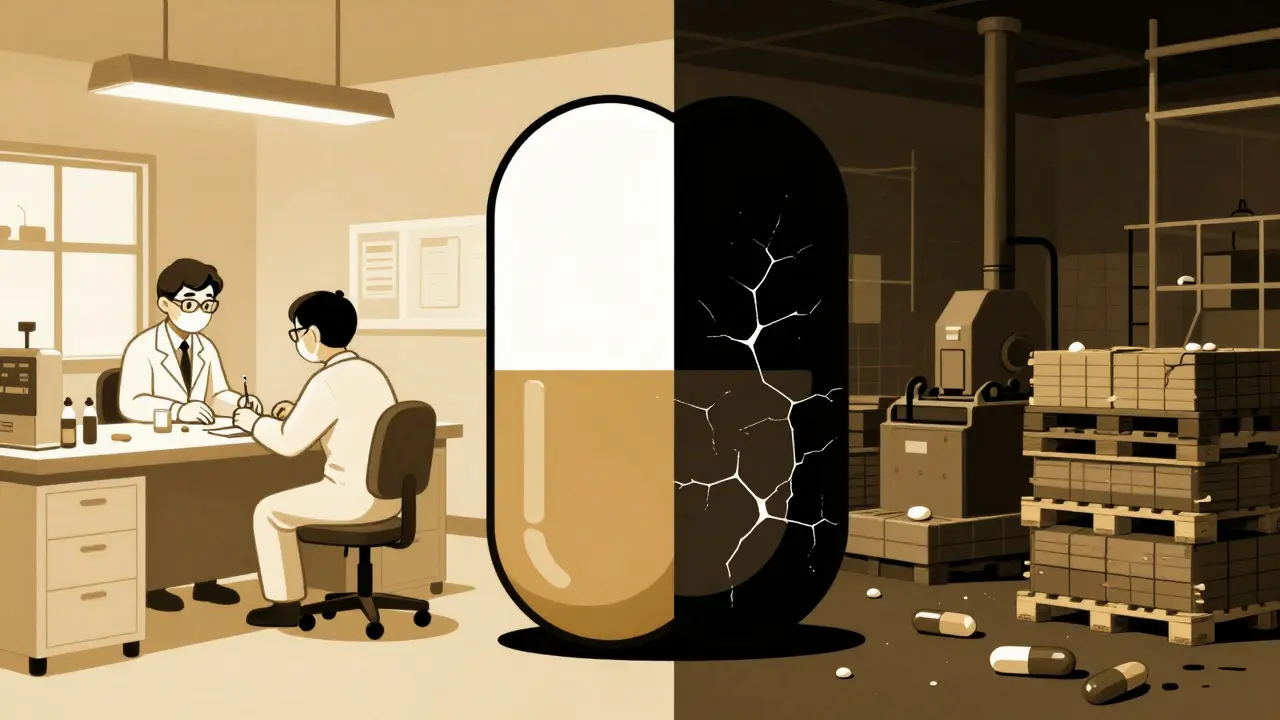
Pharmacy Reimbursement: The MAC Trap
When you walk into a pharmacy and get your generic medication, the pharmacy doesn’t get paid what they paid for it. They get paid based on something called the Maximum Allowable Cost, or MAC. This is a reimbursement rate set by Pharmacy Benefit Managers (PBMs) - the hidden power brokers of the system. PBMs control about 80% of the U.S. prescription market. CVS Caremark, OptumRX, and Express Scripts decide how much pharmacies get reimbursed for every generic drug. They don’t base it on what the pharmacy actually paid. They base it on a blended average of what other pharmacies paid - often from different manufacturers, different batches, different prices. Here’s the trap: if your pharmacy bought a bottle of metformin for $3.50, but the MAC is $3.10, you lose 40 cents on every prescription. That’s not a rounding error - that’s a financial crisis. According to a 2023 survey by the American Pharmacists Association, 68% of independent pharmacies say MAC pricing is below their actual acquisition cost. Many are forced to stop carrying certain generics altogether. Others charge patients extra out-of-pocket. It’s a broken system.Who Really Profits?
Let’s talk money. When you pay $4 for a generic drug, where does that money go? A 2024 analysis by the Association for Accessible Medicines showed that generic manufacturers only capture 36% of the total spending. The rest? Goes to wholesalers, PBMs, pharmacies, and insurance companies. Compare that to brand-name drugs, where manufacturers keep 76% of the revenue. The difference? Brand drugs use list-price-based reimbursement. Generics use MAC. And MAC is set by PBMs - who also negotiate rebates with brand manufacturers. PBMs get paid by brand companies to put their drugs on preferred lists. They get rebates - sometimes hundreds of dollars per prescription - for pushing expensive brand-name drugs over cheaper generics. That’s why you might see a brand drug listed as “preferred” even when a generic exists. It’s not about cost. It’s about kickbacks.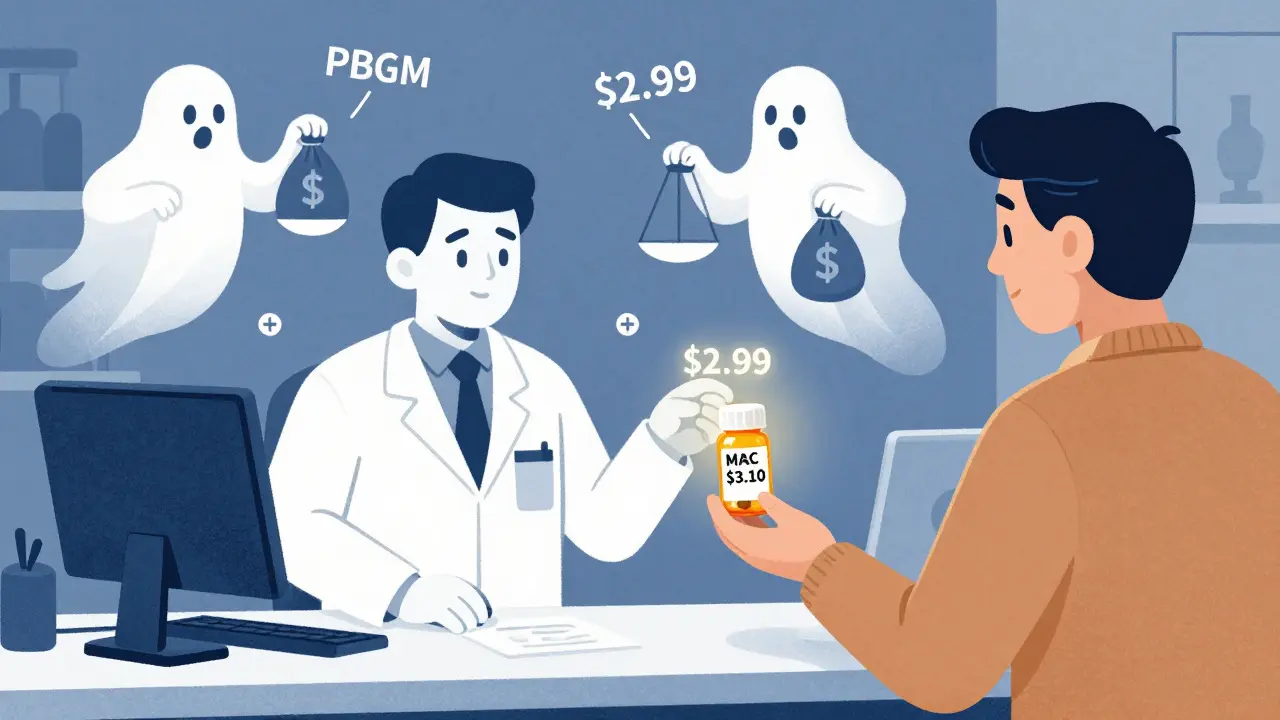
What’s Changing? AI, Blockchain, and Diversification
Some players are trying to fix this. Drug Patent Watch’s 2023 report highlighted new strategies: AI to predict demand, blockchain to track pills from factory to shelf, and diversified sourcing to avoid over-reliance on one country. A few manufacturers are now building API facilities in Eastern Europe and Mexico. Others are partnering directly with pharmacies, cutting out wholesalers entirely. But these are exceptions. The system still runs on inertia. The FDA is trying to speed up approvals. The Inflation Reduction Act of 2022 is forcing Medicare to negotiate prices - which could trickle down to generics. And more pharmacies are banding together to form buying groups, pooling their power to negotiate better prices. Still, the core problem remains: the generic supply chain was built for volume, not resilience. It’s optimized for low cost, not reliability. And when a storm hits - a natural disaster, a war, a regulatory crackdown - the whole thing shudders.What This Means for You
You don’t need to understand the entire supply chain to get your medicine. But you should know this: the cheap drug you’re taking is the result of a global, high-stakes game. The price you pay isn’t just about manufacturing. It’s about who gets paid, who gets squeezed, and who holds the power. If you’re on a fixed income, ask your pharmacist: “Is this generic covered under MAC? What’s the real cost?” Some pharmacies offer cash prices lower than insurance reimbursement. Others have patient assistance programs. And if your pharmacy stops carrying a drug you need - it’s not just bad luck. It’s systemic failure. The system works - for now. But it’s built on thin ice. And when it cracks, it’s not the manufacturers or the PBMs who feel it. It’s you.Why are generic drugs so much cheaper than brand-name drugs?
Generic drugs are cheaper because they don’t need to repeat expensive clinical trials. They only need to prove they’re chemically identical to the brand-name version. This approval process, called an ANDA, costs far less than developing a new drug. Plus, once multiple manufacturers start making the same drug, competition drives prices down. Brand drugs, on the other hand, recover R&D costs through high initial pricing, and they often use rebates and marketing to maintain market dominance.
Why do pharmacies sometimes run out of generic drugs?
Many generic drugs rely on a single manufacturer or a single overseas facility for their active ingredient. If that factory has a quality issue, shuts down for inspection, or faces a shipping delay, the drug vanishes. The supply chain has no backup. With over 88% of active ingredients made outside the U.S., disruptions from natural disasters, political instability, or trade policies can cause nationwide shortages. The FDA tracks over 200 drugs at risk of shortage at any given time.
What is MAC, and why does it matter to pharmacies?
MAC stands for Maximum Allowable Cost. It’s the highest amount a Pharmacy Benefit Manager (PBM) will reimburse a pharmacy for a generic drug. It’s not based on what the pharmacy actually paid - it’s based on an average of what others paid. If your pharmacy bought the drug for $3.50 but the MAC is $3.10, they lose money on every prescription. Many independent pharmacies report MAC pricing is below their acquisition cost, forcing them to stop carrying certain drugs or charge patients extra.
Do PBMs really influence which generic drugs are prescribed?
Yes. PBMs control formularies - the lists of drugs insurance plans cover. They often favor brand-name drugs over generics because they receive rebates from drugmakers for doing so. Even when a cheaper generic exists, a PBM might push a more expensive brand drug onto the preferred list. This isn’t always obvious to patients or doctors, but it affects what you’re prescribed and what you pay.
Can I find out where my generic drug was made?
Not easily. The FDA doesn’t require manufacturers to list the origin of the active ingredient on the label. Some pharmacies may know based on distributor records, but most don’t. You can sometimes find this information by searching the drug’s National Drug Code (NDC) on the FDA’s website, but it’s not user-friendly. Transparency is still a major gap in the system.
Is there a way to avoid the MAC pricing trap as a patient?
Yes. Ask your pharmacy for the cash price. In many cases, it’s lower than the insurance copay - especially if the MAC is below the pharmacy’s cost. Some pharmacies offer discount programs or work with nonprofit organizations to help patients afford meds. You can also ask if they carry a different manufacturer’s version - sometimes, switching brands can make a big difference in price and availability.
Understanding how your medicine gets to you isn’t just academic - it’s empowering. The next time you pick up a prescription, remember: that pill traveled halfway across the world, passed through dozens of hands, and survived a system built to cut costs - not ensure stability. You’re not just taking medicine. You’re part of a global chain that’s holding together by a thread.


Comments (9)