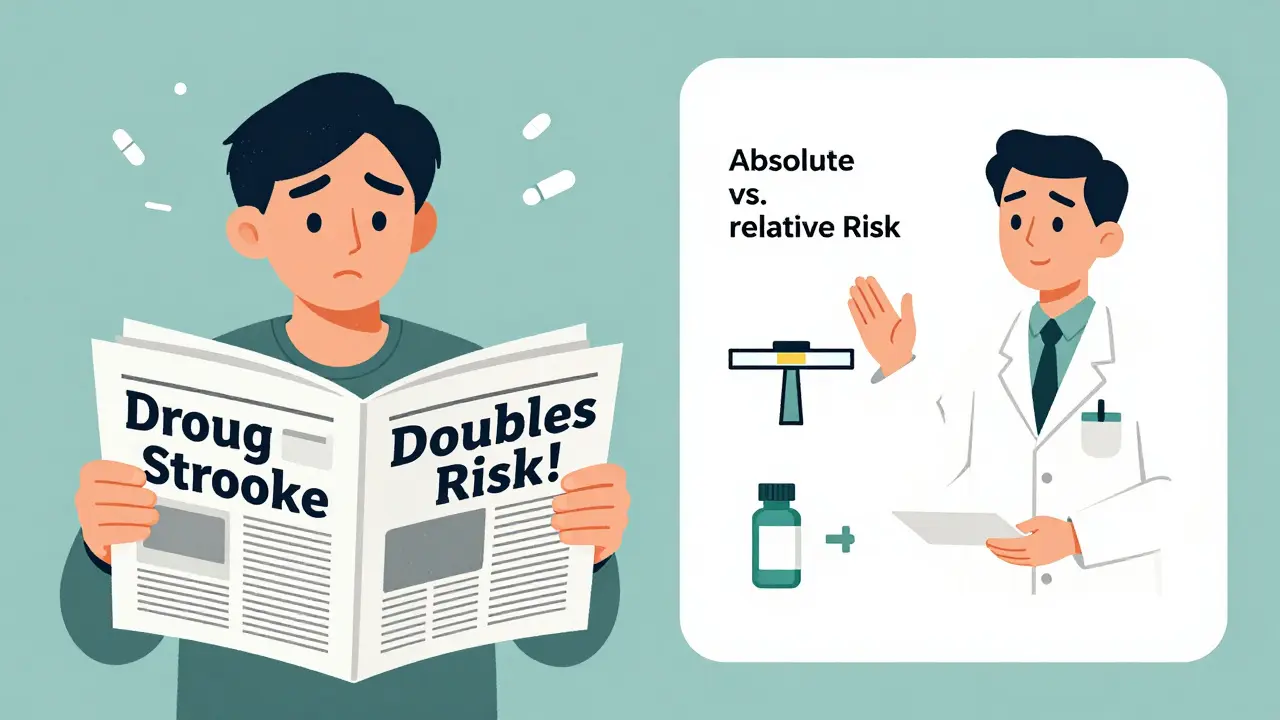
When you read a headline like "New Study Links Blood Pressure Drug to 50% Higher Risk of Stroke," your heart might race. You might even consider skipping your next dose. But before you do, stop. Most of these stories aren’t lying-they’re just incomplete. And in the world of medication safety, incomplete can be dangerous.
Medication Errors vs. Adverse Drug Reactions: The First Thing You Must Know
Not every bad outcome from a drug is the drug’s fault. This is the most basic, most ignored distinction in media reporting. A medication error is something that went wrong in the process: a doctor wrote the wrong dose, a pharmacist gave you the wrong pill, a nurse administered it at the wrong time. These are preventable. They’re system failures. An adverse drug reaction (ADR) is a harmful effect that happens even when the drug is used correctly. Some people are just more sensitive. Some reactions are rare, unpredictable, and unavoidable. A 2021 study in JAMA Network Open found that 68% of media reports didn’t clarify which one they were talking about. That’s a problem. If a news story says a drug "caused" heart failure, but it’s actually about a medication error in a hospital with outdated systems, you’re being misled. The drug might be perfectly safe when used right.Relative Risk vs. Absolute Risk: Why Numbers Lie
You’ve probably seen this: "Drug X doubles your risk of liver damage!" Sounds terrifying. But what if your original risk was 1 in 10,000? Doubling it means 2 in 10,000. Still tiny. This is the difference between relative risk and absolute risk. Media reports love relative risk because it sounds dramatic. But absolute risk tells you what actually matters to you. A 2020 BMJ study looked at 347 news articles on drug risks. Only 38% reported both. Cable news did worse than print. Digital-only outlets? Only 22% got it right. Always ask: "What’s the baseline risk?" If the article doesn’t say, it’s hiding something. A real safety report will give you both numbers. If you’re on a statin and the news says it "increases diabetes risk by 25%," check the original study. Is that 25% of 1%? Or 25% of 10%? That’s the difference between 0.25% and 2.5% extra risk.How Was the Data Collected? (And Why It Matters)
Not all studies are created equal. The way researchers find drug safety problems changes what they find. There are four main methods:- Incident reports - Hospitals and pharmacies voluntarily report mistakes. These are easy to collect but miss most errors. Only 5-10% of real mistakes get reported.
- Chart reviews - Researchers dig through medical records. More thorough, but still only catch a fraction of problems. They also can’t prove the drug caused the issue-just that it happened around the same time.
- Direct observation - Someone watches nurses give meds. This finds the most errors, but it’s expensive and rare in real-world studies.
- Trigger tools - A smart system flags warning signs in patient data (like a sudden spike in potassium levels). This is the most efficient method and is used by top hospitals. It’s also the most reliable for finding real safety signals.
Where Did the Data Come From? (Spoiler: It’s Probably Not What You Think)
You’ll often see headlines like: "FDA Warns of 1,200 Deaths Linked to Drug Y." That sounds like proof the drug is deadly. But here’s the truth: the FDA’s database (FAERS) collects reports, not confirmed causes. Anyone can report a side effect-doctors, patients, even family members. And they often report events that happened around the same time as taking the drug, even if it’s unrelated. That’s called a temporal association. It’s not causation. A 2021 study in Drug Safety found only 44% of media reports explained this. They treated every report as a confirmed death caused by the drug. That’s wrong. The FAERS database is a starting point for investigation-not a verdict. Same goes for the WHO’s global database. It’s useful, but underreporting is massive. Experts estimate 90-95% of adverse events never get reported. So if a headline says "5,000 cases in the WHO database," that likely means hundreds of thousands happened in real life-and we just don’t know about them.
Are They Confusing the Drug or the Dose?
A 2022 Reddit thread with over 3,000 upvotes exposed a common trap. A news story claimed a blood pressure drug was "deadly." The study? It used doses 10 times higher than what’s ever prescribed in real life. This happens all the time. Studies test extreme doses to find potential risks. That doesn’t mean the drug is dangerous at normal doses. But media reports rarely mention this. Always check: "What dose was used in the study?" If the answer isn’t there, the story is incomplete.Did They Check for Confounding Factors?
People who take new, expensive drugs often have more health problems. They’re sicker to begin with. They see doctors more. They take more meds. So if they have a heart attack, is it the new drug-or their diabetes, high blood pressure, and smoking habit? Good studies control for these things. They match groups so the only difference is the drug. Bad studies don’t. A 2021 audit in JAMA Internal Medicine found only 35% of media-described studies mentioned controlling for confounding factors. That means two out of three stories are missing the biggest source of error in drug safety research.Who’s Behind the Story? (And What’s Their Agenda?)
The global medication safety monitoring market is growing fast-projected to hit $6.8 billion by 2030. That’s billions in profit from software, data systems, and consulting. Some companies fund research or quietly influence how results are framed. Also, direct-to-consumer drug advertising has tripled since 2015. When a drug maker sponsors a safety study, it’s not always obvious. And when a media outlet runs a story about a "dangerous" drug, it might be because they’re promoting a competitor’s product. Check the funding source. Look for disclosures. If the article doesn’t say who paid for the research, be skeptical.What Do the Experts Say? (And Are They Being Quoted?)
The Institute for Safe Medication Practices (ISMP) publishes a list of error-prone abbreviations and dangerous dosing patterns every year. If a media report mentions "mg" without specifying "milligrams" or uses "U" for units (which can be mistaken for "0"), that’s a red flag. A 2022 analysis found that outlets consulting ISMP had 43% fewer factual errors. Also, look for quotes from real experts-not just "a doctor said." Who? What’s their title? Where do they work? A quote from a hospital pharmacist who works in medication safety carries more weight than a "health expert" from a PR firm.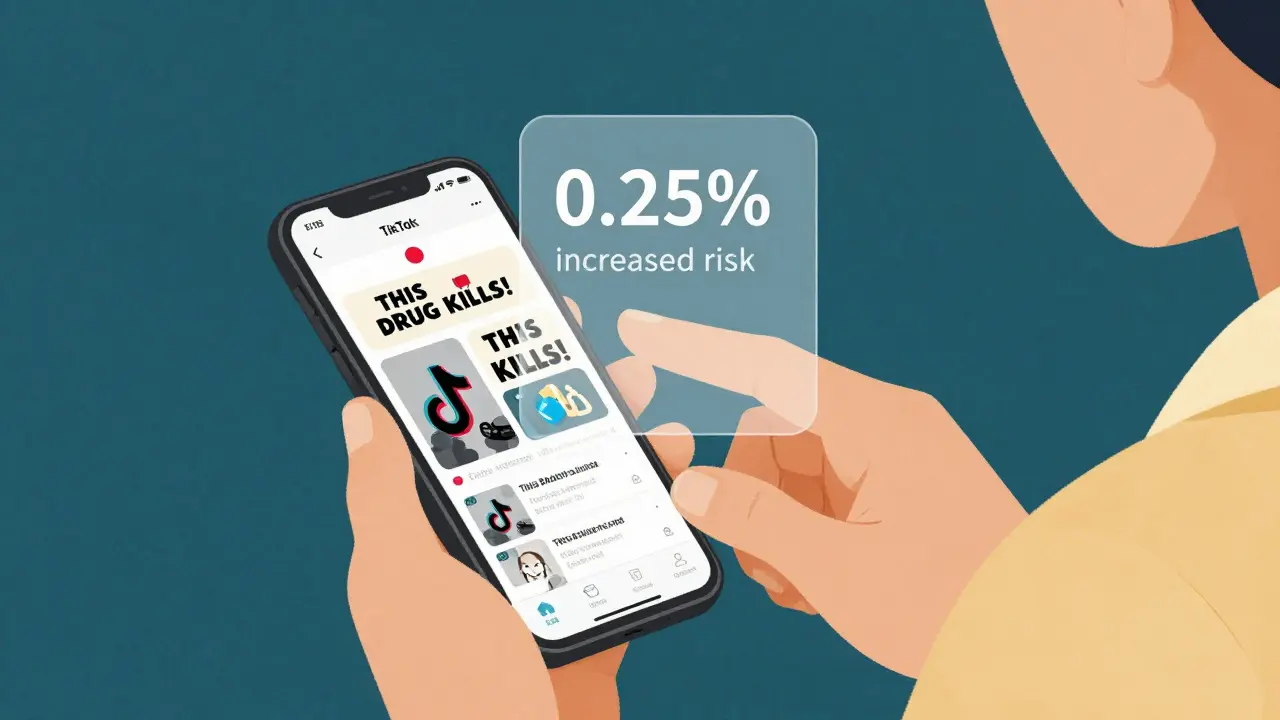
What About Social Media?
Instagram and TikTok are the worst offenders. A 2023 analysis by the National Patient Safety Foundation found 68% of medication safety claims on those platforms were wrong. Stories about "natural cures" replacing prescriptions, or panic over "toxic ingredients," spread fast. A 2023 Kaiser Family Foundation survey found 61% of U.S. adults changed their medication use after reading a news story. 28% stopped taking their prescription entirely. If you’re considering stopping a drug because of a viral post, pause. Talk to your pharmacist. Ask them to look at the original study. They’re trained to read between the lines.What Should You Do Next?
Here’s your quick checklist before you believe or act on a medication safety story:- Does it distinguish between medication errors and adverse drug reactions? If not, it’s misleading.
- Does it give absolute risk, not just relative risk? If it says "doubles the risk," ask: "Doubles what?"
- What method was used? Trigger tool? Chart review? Incident report? If it’s not stated, the study is probably weak.
- Where did the data come from? FAERS? WHO? A hospital study? If it’s just "a study," dig deeper.
- Was the dose realistic? Was it tested at 10x the normal dose? That’s not a warning-it’s a lab experiment.
- Were confounding factors controlled? Did they account for age, other drugs, existing conditions?
- Is there a funding disclosure? Who paid for this? Is there a conflict of interest?
- Are real experts quoted? Not "a doctor," but a specific person with a real title and affiliation.
- Is this on social media? If yes, double-check everything. Error rates are 68% on TikTok and Instagram.
Where to Find Real Data (Not Just Headlines)
If you want to see what’s really going on, go to the source:- FDA’s FAERS database - Search for reports on specific drugs. Remember: reports ≠ confirmed side effects.
- ClinicalTrials.gov - Find the original study. Read the methods section.
- ISMP’s List of Error-Prone Abbreviations - Helps you spot sloppy reporting.
- WHO’s ATC Classification - Helps you verify if the drug is correctly named and categorized.
- Leapfrog Hospital Safety Grade - If a story says "your hospital is unsafe," check if it’s listed here.


Comments (16)