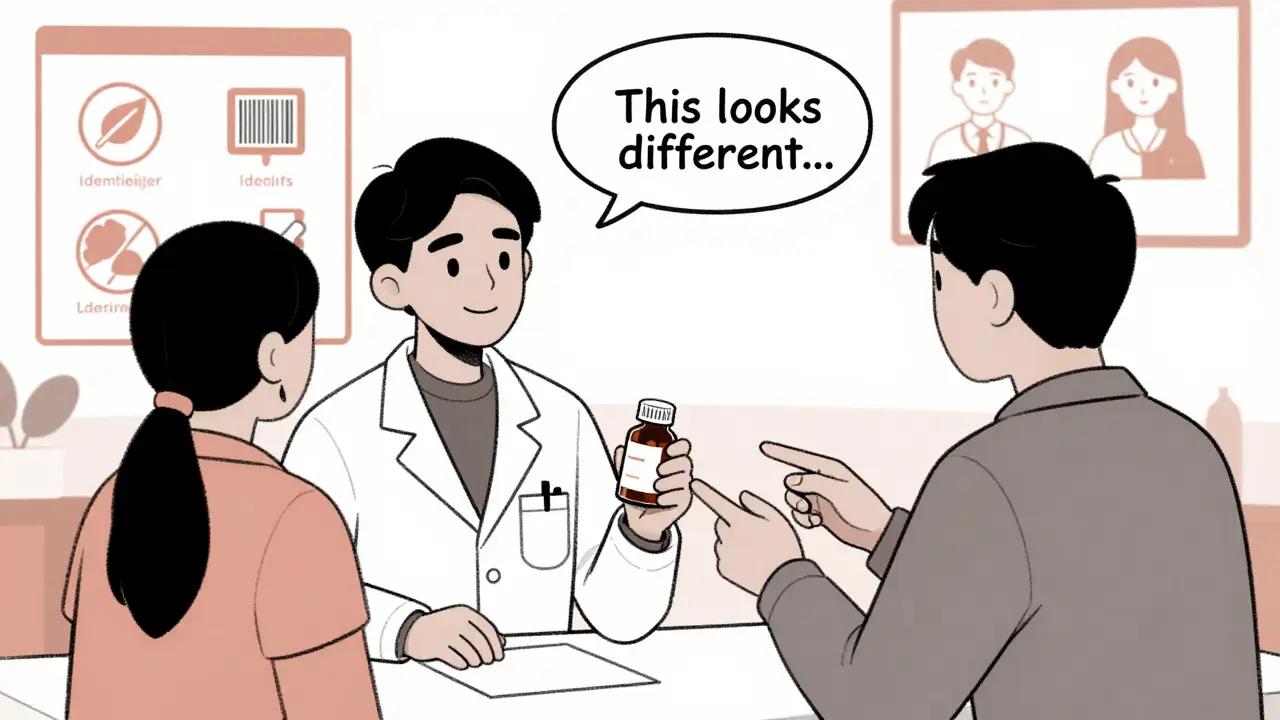
Imagine walking up to the pharmacy counter, handing over your prescription, and walking away with someone else’s medicine. It sounds impossible - but it happens more often than you think. Every year, thousands of patients in the U.S. get the wrong medication because a pharmacist accidentally handed it to the wrong person. These aren’t minor mistakes. They can cause allergic reactions, dangerous drug interactions, or even death. And the worst part? Wrong-patient errors are completely preventable.
Why Wrong-Patient Errors Happen
Wrong-patient errors don’t occur because pharmacists are careless. They happen because the system is overloaded. During peak hours, a pharmacy technician might be juggling 10 prescriptions at once. A patient with a common name like John Smith walks in. Another John Smith picks up a prescription right after. One gets insulin. The other gets blood pressure pills. One person could end up in the ER. The other could suffer a stroke. According to the Institute for Safe Medication Practices (ISMP), wrong-patient errors are among the most dangerous types of medication mistakes. The Joint Commission has tracked them as a top cause of serious patient harm since 2003. A 2022 report from the Agency for Healthcare Research and Quality found that medication errors send about 1.3 million people to emergency rooms each year - and a significant chunk of those are due to the wrong patient getting the wrong drug. A big part of the problem? Sound-alike and look-alike names. ECRI Institute found that 22% of wrong-patient errors happen because two patients have names that are too similar. Add in similar birthdays, similar-looking ID cards, or a rushed pickup line, and the risk multiplies.The Two-Identifiers Rule: Your First Line of Defense
The simplest, most proven way to stop these errors? Always use two patient identifiers before handing out any medication. That means asking for:- Full legal name
- Date of birth
Barcode Scanning: The Game-Changer
If two identifiers are the first line of defense, barcode scanning is the second - and far more reliable. Here’s how it works: Each patient gets a unique barcode on their ID card or pharmacy loyalty card. When they arrive, the tech scans that barcode. The system instantly matches it to the prescription in the queue. If the names don’t match, or if the prescription isn’t for that person, the system won’t let the transaction go through. Walgreens rolled this out across 9,000+ stores in 2021. Within 18 months, wrong-patient errors dropped by 63%. A 2023 study in the American Journal of Health-System Pharmacy showed similar results in hospital pharmacies using RFID wristbands - 78% fewer errors. These systems don’t just catch mistakes. They create a digital paper trail. Every scan is logged. If something goes wrong, you can trace exactly where the breakdown happened. The downside? Cost. Installing barcode scanners, integrating them with pharmacy software, and training staff can run $15,000 to $50,000 per location. That’s a big hurdle for small, independent pharmacies.Combining Methods: The 89% Solution
The most effective approach isn’t just one tool - it’s a combo. A 2023 study in the Journal of the American Pharmacists Association found that pharmacies using both two-identifier verification and barcode scanning saw wrong-patient errors drop by 89%. That’s nearly elimination. But here’s the secret weapon most people overlook: patient counseling. When a pharmacist sits down with the patient and says, “This is metformin for your diabetes. You take one pill daily with breakfast,” something powerful happens. The patient listens. They compare it to what they were told before. They notice if the pill looks different, or if the dose changed. Pharmacy Times found that 83% of dispensing errors are caught during this final conversation. That’s not just good service - it’s a safety net.
What About New Tech? Fingerprint, Voice, AI
The future is here - and it’s biometric. Walgreens started a pilot in January 2025 with fingerprint verification in 500 stores. Preliminary results showed 92% accuracy in matching patients to prescriptions. That’s better than names and birthdays. Other chains are testing voice recognition and facial matching. Dr. Robert99, Chief Safety Officer at Lumistry, predicts that by 2027, 70% of pharmacies will use AI-assisted identification to confirm patient identity. But here’s the catch: technology alone won’t fix this. A barcode scanner won’t help if the tech skips the scan because they’re behind on work. A fingerprint reader won’t stop someone from handing a prescription to the wrong person if the culture doesn’t empower staff to pause and verify. Dr. Beth Kollisch from ECRI Institute says the most successful pharmacies share three things:- Standardized identification protocols
- Technology that makes verification automatic
- A culture where any staff member - even a cashier - can stop the process if something feels off
What Patients Can Do
You’re not just a passive recipient of care. You can help prevent these errors too.- Always bring your ID - even if you’re a regular.
- Know your date of birth. Don’t assume the pharmacy has it right.
- Ask: “Is this medication for me?” before you leave.
- If your pill looks different from last time, ask why.
- Don’t be embarrassed to say, “I’m not sure this is right.”
Implementation: How to Make This Work
If you’re running a pharmacy, here’s how to start:- Train every staff member on the two-identifier rule. Don’t assume they know it.
- Introduce barcode scanning if you can afford it. Start with one counter, test it for 30 days.
- Require counseling for every new prescription - even if it’s just 60 seconds.
- Use software like PioneerRx or QS/1 that forces dual-identifier entry before dispensing.
- Track near-misses. If someone almost got the wrong med, log it. No blame. Just learn.
- Days 1-30: Train staff. Run mock scenarios.
- Days 31-60: Pilot the system. Monitor error rates.
- Days 61-90: Full rollout. Review logs. Adjust.
- Two-identifier verification
- Barcode scanning
- Staff empowerment to pause any transaction
- Regular safety huddles