What Those Little Words on Your Prescription Really Mean
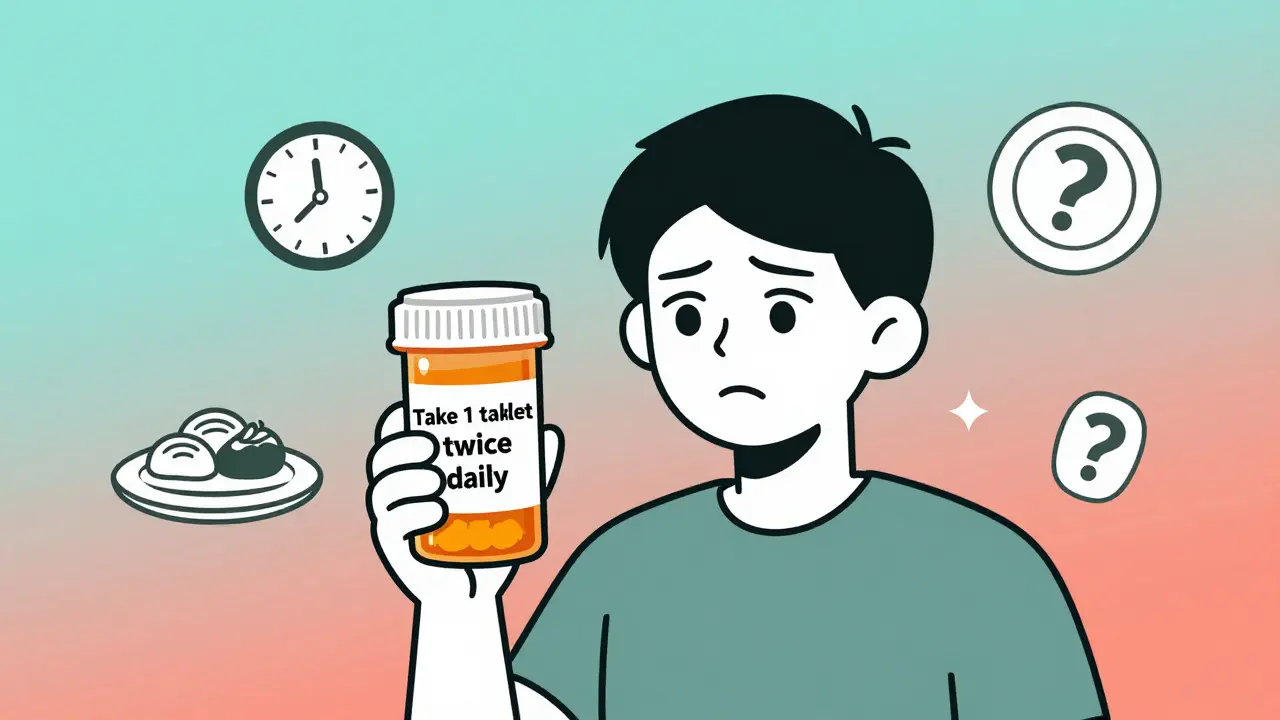
You pick up your prescription, glance at the label, and see: Take 1 tablet twice daily. It seems simple. But how many times have you wondered - does that mean 8 a.m. and 8 p.m.? Or just any two times? What if you eat breakfast at 10 a.m. and dinner at 7 p.m.? Does it matter?
These aren’t just minor details. Misreading dosage instructions is one of the top reasons people end up in the hospital from medication errors. In the U.S., nearly half of all reported medication mistakes happen because someone didn’t understand when or how often to take their pills. The FDA says 43.7% of these errors come from vague timing like “twice daily” instead of clear instructions like “take one pill with breakfast and one with dinner.”
And it’s not just about forgetting. It’s about confusion. A 2023 survey found that 41% of adults have taken a medication at the wrong time because they didn’t understand the label. That’s more than 1 in 3 people.
Why “Twice Daily” Is a Problem - and What “Take with Breakfast” Means
Doctors and pharmacists used to write prescriptions with abbreviations like b.i.d. (bis in die) or t.i.d. (ter in die). But here’s the truth: only 37% of patients know what those mean. The American Medical Association stopped recommending them in 2021 because they’re confusing, outdated, and dangerous.
“Twice daily” sounds easy - until you’re working nights, caring for kids, or have a shifting schedule. If your label says “take twice daily,” you might take one at 8 a.m. and the next at 8 p.m. But what if you don’t eat dinner until 9? Or skip breakfast? What if you’re supposed to take it on an empty stomach? You don’t know.
Compare that to a label that says: Take 1 tablet with breakfast and 1 tablet with dinner. Now you have context. You know to take it with food. You know when to expect it. You’re more likely to remember. A 2021 study at Massachusetts General Hospital showed patients who got this kind of instruction were 34.7% more likely to take their meds correctly.
It’s not just about timing - it’s about linking the dose to your daily routine. That’s why experts now say: Always look for action-based instructions. “With meals,” “before bed,” “on an empty stomach” - these tell your body when to expect the medicine and how it will work.
What “As Needed” Really Means - And Why You’re Probably Using It Wrong
“Take as needed for pain” sounds flexible. But it’s one of the most dangerous phrases on a label.
A 2023 Consumer Reports survey found that 68% of people who got this instruction didn’t know the maximum number of doses they could take in a day. That’s how people end up taking 6 pills instead of 2 - and risking liver damage from acetaminophen or stomach bleeding from NSAIDs.
Proper “as needed” labels should include two things: the maximum number of doses per day and the minimum time between doses. For example:
- Take 1 tablet every 6 hours as needed for pain - do not exceed 4 tablets in 24 hours.
- Take 1 tablet as needed for anxiety - maximum 2 tablets per day.
If your label doesn’t say this, ask your pharmacist. Don’t guess. Overdosing on “as needed” meds is one of the leading causes of emergency room visits for medication errors.

Why Metric Units Matter - And Why “Teaspoon” Is a Trap
For liquid medicines, the unit of measure is just as important as timing. The FDA and U.S. Pharmacopeia have been pushing for years to stop using teaspoons and tablespoons on labels. Why? Because they’re inconsistent.
A household teaspoon holds anywhere from 3 to 7 milliliters. A standard measuring spoon? 5 mL. A pharmacy dosing cup? Exactly 5 mL. If your label says “take one teaspoon,” and you use a kitchen spoon, you might be giving your child 20% more - or less - than the dose.
Since 2020, the National Council for Prescription Drug Programs has required all oral liquid medications to use milliliters (mL) only. But here’s the problem: a 2021 FDA audit found that 63.8% of pharmacy labels still used teaspoons or tablespoons.
Always check your liquid medication label. If it says “1 tsp,” ask for a new label that says “5 mL.” And never use a kitchen spoon. Always use the dosing cup, syringe, or dropper that came with the medicine. Even a 1 mL mistake can be dangerous for children or elderly patients.
What to Do When Your Schedule Doesn’t Fit the Label
What if you work nights? What if you’re a shift worker and “morning” and “evening” don’t apply to you? What if you take your insulin at 11 p.m. because that’s when you eat dinner?
Some labels are too rigid. A 2022 study found that 22% of night-shift workers misinterpreted “take in the morning” and “take at night” because their day/night cycle was flipped.
Here’s what to do: Ask your pharmacist to rewrite the timing based on your routine. They can change “take with breakfast” to “take when you wake up” or “take with your first meal of the day.” Pharmacists are trained to do this. You just have to ask.
For time-sensitive meds - like those for epilepsy, heart conditions, or cancer - timing matters even more. Some drugs need to be taken within a 2-hour window. If your label says “take between 8 a.m. and 10 a.m.,” don’t push it to noon. That could make the drug less effective or even dangerous.

What’s Changing - And What You Should Expect by 2027
The system is slowly improving. Since January 2024, all new drug applications in the U.S. must include clear, explicit timing instructions on the patient label. By 2027, every prescription label will be required to include a Medication Schedule Grid - a simple chart showing exactly when to take each dose, day by day.
Some states are already ahead. California’s Senate Bill 1333, effective January 2024, requires all prescriptions to include both explicit timing and pictograms - tiny icons showing a pill with a clock, or a person eating, to visually guide patients.
Pharmacies are also starting to use digital tools. Some now offer QR codes on labels you can scan with your phone to see a video of how and when to take your medicine. In a pilot program, this reduced timing errors by over 50%.
By 2026, the U.S. government aims for 90% of pharmacies to use these clear, visual instructions. That means fewer mistakes. Fewer hospital visits. More people taking their meds right.
What You Can Do Right Now
You don’t have to wait for the system to fix itself. Here’s what to do the next time you get a prescription:
- Read the label out loud. If it says “twice daily,” ask: “Can you write it as ‘take one pill at breakfast and one at dinner’?”
- Check the units. For liquids, make sure it says “mL,” not “teaspoon” or “tablespoon.”
- Ask about “as needed.” “What’s the max I can take in a day?”
- Ask about timing. “Should I take this on an empty stomach?” “Can I take it with coffee?”
- Use a pill organizer. Fill it once a week. Label each section with the time or meal.
- Take a photo of the label. Save it on your phone. Review it before you take your pill.
Pharmacists are your best ally. They’re not just filling prescriptions - they’re safety checks. Don’t be shy. Ask questions. If you’re confused, you’re not alone. But you’re the only one who can make sure you get it right.
When in Doubt, Call Your Pharmacist
There’s no shame in calling your pharmacy and saying: “I’m not sure how to take this.”
They’ve seen it all - from patients who took their blood pressure pill at bedtime instead of morning to those who mixed up insulin doses. They’ve trained for this. They want you to be safe.
And if they give you an answer that doesn’t make sense? Ask again. Or ask another pharmacist. Medication safety is your right - not a bonus feature.
The goal isn’t perfection. It’s understanding. And every time you ask a question, you’re helping yourself - and maybe someone else who sees your label and thinks, “I didn’t know that.”


Comments (13)