
Dark spots on your face don’t always mean the same thing. Two of the most common causes - melasma and sun damage - look similar, but they’re totally different behind the scenes. And if you treat them the same way, you could make things worse. Knowing the difference isn’t just about looks; it’s about choosing the right treatment and avoiding costly mistakes.
What’s Really Going On With Your Skin?
Hyperpigmentation means your skin makes too much melanin - the pigment that gives skin its color. But why? Melasma and sun damage both cause dark patches, but their triggers are worlds apart.Melasma shows up as large, blurry patches on the cheeks, forehead, nose, or upper lip. It’s most common in women with medium to dark skin tones (Fitzpatrick types III-VI). Hormones play a big role: pregnancy, birth control pills, and hormone therapy can all trigger it. But it’s not just hormones. Visible light from windows, indoor lighting, and even heat can stimulate melanocytes (the cells that make pigment). That’s why even staying indoors won’t stop it if you’re not protected properly.
Sun damage (also called solar lentigines or liver spots) looks like small, well-defined brown spots. They show up on areas that get the most sun - face, hands, shoulders. These aren’t caused by hormones. They’re caused by years of UV exposure. DNA damage in melanocytes leads to clusters of extra pigment. About 90% of fair-skinned people over 60 have them. They’re predictable. They respond well to treatment. But melasma? Not so much.
Why Your Sunscreen Might Be Failing You
Most people think sunscreen is sunscreen. That’s the biggest mistake.Standard sunscreens block UV rays - UVA and UVB. But melasma doesn’t care just about UV. Visible light (VL) and infrared radiation also trigger pigment production. Studies show visible light contributes to 25-30% of melasma cases. That means if you’re using a regular chemical sunscreen, you’re leaving your skin vulnerable.
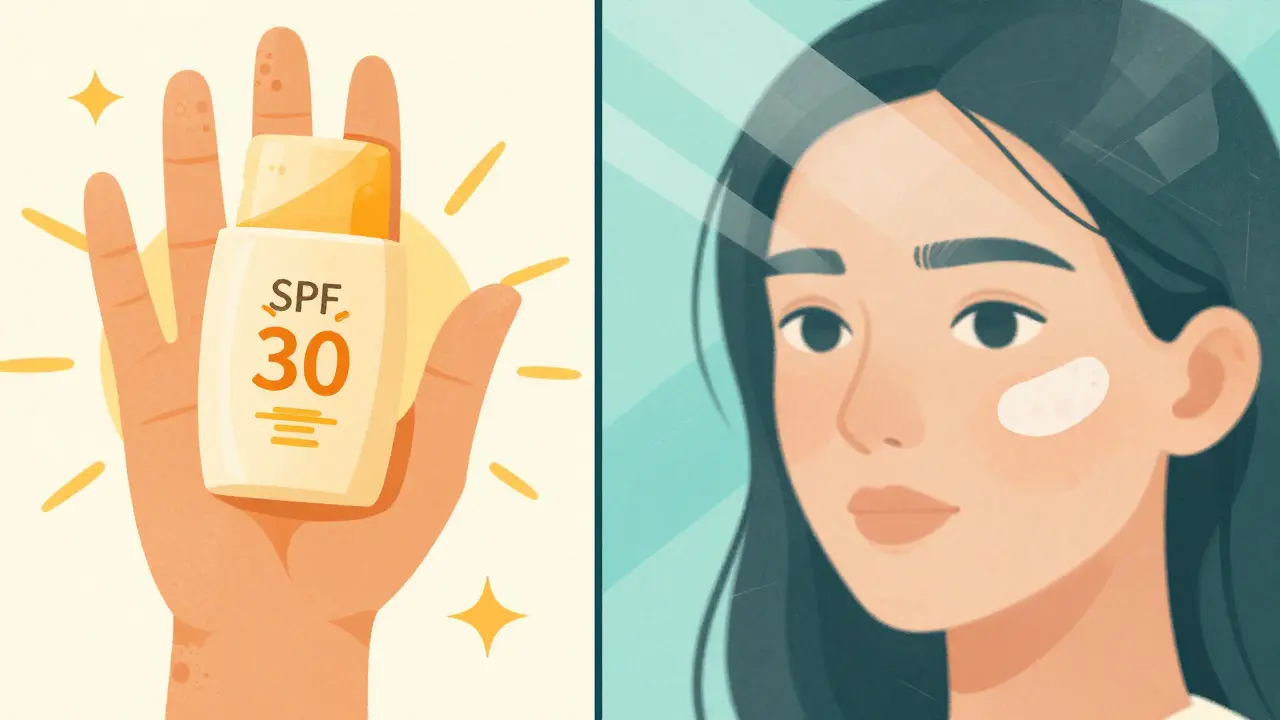
Experts like Dr. Kourosh from Harvard Medical School say, “The sun is stronger than any medicine I can give you.” For melasma, you need mineral-based sunscreens with zinc oxide and iron oxides. Iron oxides are key - they block visible light. Use SPF 50+, apply a full 1/4 teaspoon to your face, and reapply every two hours if you’re outside. Even if you’re indoors near a window, you need protection. Visible light penetrates glass.
For sun damage, broad-spectrum SPF 30+ is usually enough. But for melasma? You need armor. Skip the tinted moisturizer with SPF 15. Go for a physical barrier with iron oxide. It’s not optional - it’s essential.
Topical Treatments: What Works and What Doesn’t
There are dozens of creams, serums, and lotions on the market. But only a few have solid science behind them.Hydroquinone (4%) is still the gold standard for melasma. It blocks the enzyme tyrosinase, which your skin uses to make melanin. When used alone, it helps about 40% of people. But when combined with tretinoin (0.05%) and a corticosteroid (like hydrocortisone), it works for 50-70% of patients within 12 weeks. This triple combo is now the first-line treatment for moderate melasma - up from 45% in 2018 to 75% today. But don’t use it longer than 3 months. Long-term use can cause exogenous ochronosis - a paradoxical bluish-brown discoloration that’s hard to reverse.
Tretinoin (a retinoid) doesn’t lighten pigment directly. Instead, it speeds up skin cell turnover. Think of it like a gentle exfoliator that pulls melanin out of the surface layers. It’s usually used at night, alternating with hydroquinone to reduce irritation. About 30-40% of users get redness or peeling, so start slow - every other night, then build up.
Vitamin C (L-ascorbic acid at 10-20%) works as an antioxidant. It doesn’t block melanin production. Instead, it neutralizes oxidized melanin, making dark spots look lighter. It also blocks tyrosinase. Use it in the morning under sunscreen. A 15% concentration is ideal. It’s safe for long-term use and pairs well with other treatments.
Other options like niacinamide (5%), kojic acid, and tranexamic acid (5%) are gaining ground. Tranexamic acid, especially, is showing promise in studies - 45% improvement in melasma after 12 weeks with no major side effects. It’s now available in prescription serums and is becoming a go-to for people who can’t tolerate hydroquinone.
Laser and Light Treatments: A Double-Edged Sword
Many people turn to lasers because they promise quick results. But for melasma, they’re risky.IPL (Intense Pulsed Light) works great for sun damage. It targets pigment with heat, causing the spots to darken and flake off in 3-5 days. Success rate? 75-90% in 2-3 sessions. But for melasma? It’s dangerous. Heat triggers melanocytes. Studies show IPL worsens melasma in 30-40% of cases. That’s why dermatologists won’t touch it unless the melasma is already suppressed with 8-12 weeks of topical therapy.
Other lasers like Q-switched Nd:YAG or fractional lasers can be used cautiously - but only after pigment has been controlled with creams. Even then, recurrence rates stay high unless sun protection is perfect.
For sun damage? Lasers are safe and effective. For melasma? They’re last-resort options. Always start with topicals and sun protection. If you’re considering a laser, ask your dermatologist: “Have you suppressed the melanocytes first?”
The Real Problem: Adherence
Here’s the ugly truth: most treatments fail not because they don’t work - but because people stop using them.Only 35% of patients stick with their topical regimen for the full 3-6 months. Why? Irritation, cost, or just forgetting. Hydroquinone and tretinoin can burn or peel. Vitamin C can sting. It’s easy to quit.
And then there’s sunscreen. YES Medspa’s data shows 70% of patients use less than the recommended amount. One teaspoon for the whole face? Most use a pea-sized dab. They don’t reapply. They skip days. They think clouds protect them. They don’t realize that visible light comes through windows.
Even worse: 85% of melasma patients try OTC products first - niacinamide serums, brightening toners, “natural” remedies. These rarely help. By the time they see a dermatologist, the condition has worsened.
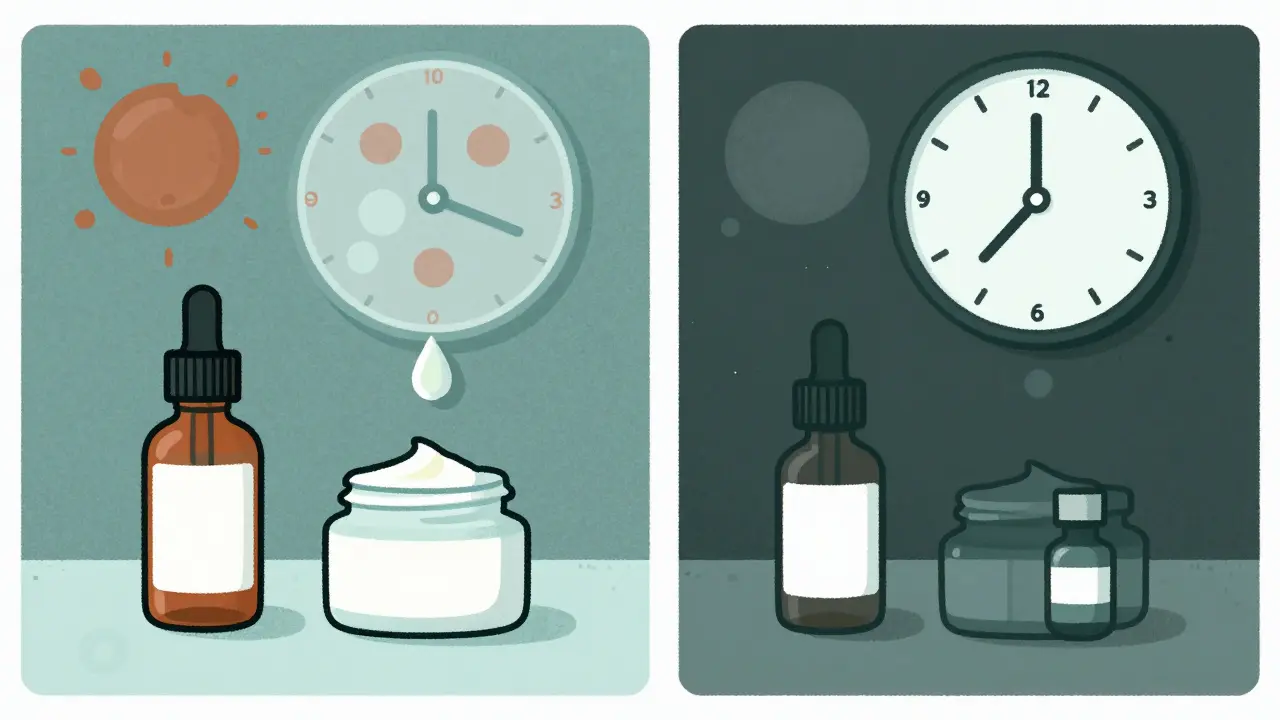
Success comes from consistency. Morning: vitamin C + mineral sunscreen. Night: hydroquinone and tretinoin on alternate nights. Every. Single. Day. No exceptions. And if you miss a day? You’re not behind - you’re resetting the clock.
What About Other Types of Dark Spots?
Not all dark spots are melasma or sun damage. There’s another common one: post-inflammatory hyperpigmentation (PIH).PIH happens after acne, eczema, or even a bad haircut (yes, razor burn can cause it). It appears where the inflammation was - not necessarily where the sun hits. It’s more common in darker skin tones - 15-30% more frequent than in lighter skin. And here’s the kicker: lasers can make PIH worse. Up to 25% of cases flare up after laser treatment.
PIH responds best to gentle topicals - niacinamide, azelaic acid, and low-dose hydroquinone. Avoid harsh scrubs or peels. Let the skin heal. Time and protection are your best allies.
What’s Next? The Future of Treatment
The field is changing fast. In 2022, the FDA proposed reclassifying hydroquinone from prescription-only to over-the-counter - with strict safety labeling. That could make it more accessible, but also riskier if misused.New agents are on the horizon. Cysteamine cream (10%) showed 60% improvement in melasma after 16 weeks in clinical trials - with almost no irritation. It’s not widely available yet, but it’s coming.
And then there’s personalized medicine. Dr. Pearl Grimes predicts that within five years, genetic testing will guide treatment. Some people’s skin overproduces melanin because of specific gene variants. Others respond better to anti-inflammatory agents. The future isn’t one-size-fits-all.
For now, the best approach is simple: sun protection first, then combination topicals, and patience. Melasma isn’t cured - it’s managed. Like high blood pressure or diabetes, it needs daily attention.
What to Do Today
- Check your sunscreen. Does it say “iron oxide” or “mineral-based”? If not, replace it.
- Stop using OTC brightening creams unless they contain proven ingredients (vitamin C, niacinamide, tranexamic acid).
- Start a routine: morning = vitamin C + SPF 50+ mineral sunscreen. Night = hydroquinone and tretinoin on alternate nights.
- Don’t rush lasers. If you’re considering one, ask your dermatologist for proof that your melanocytes are suppressed first.
- Track your progress. Take photos every 4 weeks. Improvement takes time - 8-12 weeks minimum.
Hyperpigmentation isn’t a flaw. It’s a signal. Your skin is reacting to light, hormones, or inflammation. The goal isn’t to erase it completely - it’s to control it. And that starts with understanding what you’re really dealing with.
Can melasma go away on its own?
Sometimes - but rarely. Melasma triggered by pregnancy often fades after childbirth. Birth control-related melasma may improve if you stop the pill. But without sun protection, it almost always comes back. Most people need ongoing treatment. Think of it like managing allergies - you can control it, but you can’t cure it.
Is hydroquinone safe?
When used correctly, yes. The 4% prescription strength is safe for up to 3 months. The main risk is exogenous ochronosis - a rare condition where skin turns bluish-brown from long-term use. That’s why it’s never used alone for more than 12 weeks. Always combine it with tretinoin and a steroid. Avoid over-the-counter products with unregulated hydroquinone levels - some contain 10% or more, which is dangerous.
Why does my melasma get worse in summer?
Heat and light are major triggers. UV radiation increases melanin production, but visible light from sunlight and even indoor lighting does too. Heat from saunas, hot yoga, or even a hot shower can activate melanocytes. That’s why melasma flares in summer - and why you need iron oxide sunscreen even if you’re inside.
Can men get melasma?
Yes - but it’s less common. About 10% of melasma cases occur in men, usually linked to hormone imbalances, stress, or certain medications. Men are also more likely to skip sunscreen, which makes it worse. If a man develops symmetrical dark patches on the face, melasma should be considered - not just sun damage.
How long until I see results?
At least 8-12 weeks. Melanin doesn’t disappear overnight. Topical treatments work by slowing production and speeding up turnover - it takes time. You might notice a slight lightening after 4 weeks, but real improvement usually happens between 3 and 6 months. If you don’t see change by 12 weeks, talk to your dermatologist about adjusting your regimen.
Do I need to use all these products forever?
Not forever - but maintenance is key. Once melasma improves, you can reduce the frequency of hydroquinone and tretinoin. But sunscreen? That’s forever. Even if your spots fade, stopping sun protection means they’ll return. Think of it like brushing your teeth - you don’t stop after a cavity heals.


Comments (12)