Imagine a patient who has been stable on their thyroid medication for years. They switch to a new generic manufacturer because it’s cheaper. Within six weeks, their TSH levels skyrocket, and they feel exhausted again. This isn’t just bad luck; it’s a known risk with certain generic medications, which are pharmaceutical products containing the same active ingredients as brand-name drugs but potentially different inactive components or manufacturing processes. As pharmacists, we stand at the critical intersection of cost-saving policies and patient safety. While generics make up over 90% of prescriptions in the United States, saving billions in healthcare costs, they are not always interchangeable without consequence. Knowing when to flag a problematic generic is not about doubting regulatory standards-it’s about recognizing that the "one-size-fits-all" approach to bioequivalence doesn’t work for every patient or every drug class.
The Bioequivalence Gap: Why 80-125% Isn't Always Enough
To understand why some generics fail patients, you first need to look at how they are approved. The U.S. Food and Drug Administration (FDA) requires generic drugs to demonstrate bioequivalence within an 80-125% confidence interval compared to the brand-name reference listed drug (RLD). In simple terms, this means the generic can deliver slightly less or slightly more drug into the bloodstream than the brand, and still be considered equivalent.
For most drugs, like antibiotics or statins, this variance is clinically insignificant. A 2022 meta-analysis in JAMA Internal Medicine found only a 0.3% difference in LDL reduction between brand and generic atorvastatin. However, for sensitive patients or specific drug classes, that 20% window is dangerous. Dr. Philip Alcabes, a public health professor, argues that this standard allows for variations that can be clinically significant. If a patient is on the edge of therapeutic control, a shift toward the lower end of that range can mean treatment failure, while a shift to the higher end can cause toxicity.
This regulatory framework was established by the 1984 Hatch-Waxman Act to boost competition and lower costs. It works brilliantly for the majority of medications. But as frontline providers, we must recognize that "statistical equivalence" does not always equal "individual clinical equivalence."
High-Risk Categories: Narrow Therapeutic Index Drugs
Not all generics are created equal in terms of risk. The highest danger lies with Narrow Therapeutic Index (NTI) drugs, which are medications where small changes in dose or blood concentration can lead to serious adverse effects or therapeutic failure. These drugs have a tiny margin between being effective and being harmful.
A 2021 study published in the Journal of the American Pharmacists Association found that NTI drugs demonstrated 2.3 times higher rates of therapeutic failure when multiple generic switches occurred. The FDA has designated 18 specific drugs as NTIs requiring special consideration. Key examples include:
- Levothyroxine: Used for hypothyroidism. Switching manufacturers can cause drastic shifts in TSH levels. One reported case saw a patient’s TSH rise from 2.1 to 8.7 within six weeks after a manufacturer switch.
- Warfarin: An anticoagulant where slight dosage variations can lead to bleeding or clotting risks.
- Phenytoin: An anti-seizure medication where sub-therapeutic levels can trigger life-threatening seizures.
- Digoxin: Shows the highest rate of adverse events (12.7 per 10,000 prescriptions) when switching between manufacturers compared to non-NTI drugs.
- Tacrolimus: Used in transplant patients, where a 20% difference in bioavailability could mean the difference between organ rejection and successful immunosuppression.
If you see a patient on any of these medications reporting unexplained symptoms or lab abnormalities shortly after a refill, check the manufacturer. If it has changed, flag it immediately. For NTI drugs, consistency is often safer than substitution.
Complex Formulations: Extended-Release and Dissolution Issues
Beyond NTI drugs, complex formulations present another layer of risk. Immediate-release tablets dissolve quickly, making bioequivalence easier to achieve. But extended-release (ER), sustained-release (SR), and delayed-release products rely on intricate manufacturing technologies to release the drug slowly over time.
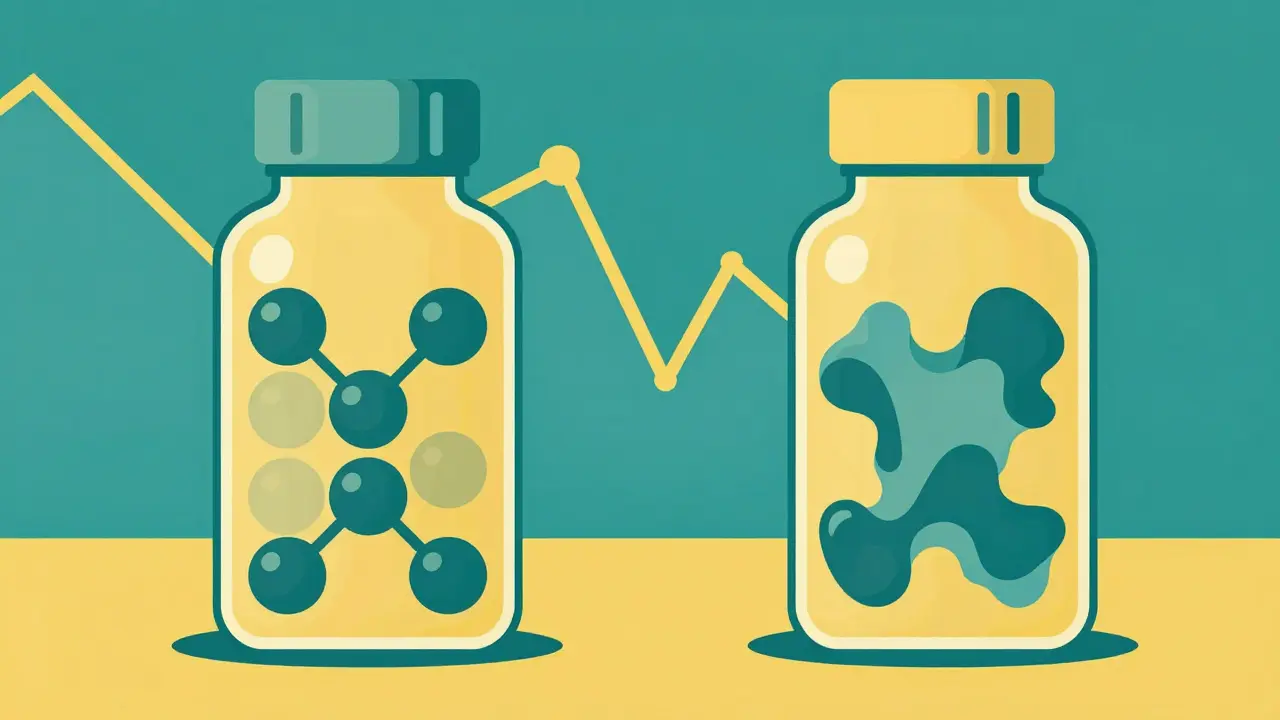
In 2020, FDA testing revealed that 7.2% of generic extended-release opioids failed dissolution testing, compared to just 1.1% of immediate-release products. Dissolution refers to how well the tablet breaks down in the body. If a generic ER product dissolves too fast, it can cause a "dose dump," leading to overdose symptoms. If it dissolves too slowly, the patient gets no relief.
The FDA issued a specific Drug Safety Communication in 2023 warning about inconsistent dissolution profiles in certain generic versions of diltiazem CD. Between January 2021 and March 2022, there were 47 reported cases of therapeutic failure linked to this issue. As a pharmacist, if a patient complains that their blood pressure medication "stopped working" or causes sudden dizziness after a switch, suspect the formulation technology, not just the active ingredient.
Look-Alike/Sound-Alike Confusion
Sometimes the problem isn’t the chemistry; it’s the name. The Institute for Safe Medication Practices (ISMP) reports that look-alike/sound-alike (LASA) name confusion accounts for 14.3% of all reported generic medication errors. Generic manufacturers often choose names that sound similar to existing brands to capitalize on recognition, or simply because naming conventions overlap.
Common culprits include:
- Oxycodone/acetaminophen vs. Hydrocodone/acetaminophen
- Simvastatin vs. Rosuvastatin
- Cymbalta (duloxetine) vs. Zyprexa (olanzapine)
Dr. Michael Cohen, President of ISMP, emphasizes that these errors are preventable but frequent. When verifying prescriptions, never assume the label matches the intent. Read the full chemical name and strength. If a LASA pair is involved, add an auxiliary label or speak directly to the patient to confirm understanding.
How to Use the FDA Orange Book Effectively
Your most powerful tool for identifying problematic generics is the FDA Orange Book, which is an official publication listing approved drug products with therapeutic equivalence evaluations. Published by the FDA, it assigns codes to indicate whether a generic is therapeutically equivalent to its brand-name counterpart.
| Code | Meaning | Pharmacist Action |
|---|---|---|
| AB | Regarded as therapeutically equivalent to the reference listed drug (RLD). | Safe to substitute in most cases. Monitor for individual response. |
| BX | Not regarded as therapeutically equivalent due to unresolved bioequivalence concerns. | Flag Issue. Do not substitute without prescriber approval. Consider brand or alternative AB-rated generic. |
| BT | Therapeutically equivalent, but differences in inactive ingredients may affect select patients. | Monitor patients with allergies or sensitivities to dyes, gluten, or lactose. |
As of October 2023, 10.3% of therapeutic equivalence codes in the Orange Book were designated as 'BX'. While this seems low, it represents thousands of products. Always check the code before dispensing, especially for chronic conditions. If you see a BX rating, contact the prescriber. Explain that the generic lacks proven equivalence data, and ask if they prefer the brand or a different generic option.
When to Flag: Practical Protocols for Pharmacists
Knowing the theory is one thing; acting on it in a busy pharmacy is another. Here is a practical checklist for when to intervene:
- New Patient Complaints: If a patient reports side effects or lack of efficacy within 2-4 weeks of a refill, check the manufacturer lot number. If it changed, document it. This data is crucial for traceback analysis.
- NTI Drug Refills: For levothyroxine, warfarin, and phenytoin, aim to maintain the same manufacturer whenever possible. If your inventory forces a switch, inform the patient and advise them to monitor for symptoms. Encourage follow-up labs sooner than usual.
- Pediatric and Geriatric Patients: These populations are more sensitive to bioavailability changes. Be extra cautious with liquid suspensions and chewable tablets, where flavoring agents and viscosity can vary significantly between generics.
- Allergy History: Generic inactive ingredients (fillers, binders, dyes) differ from brands. A patient allergic to sulfites or gluten might tolerate the brand but react to the generic. Review the package insert for excipients.
- State Law Awareness: Know your local regulations. Twenty-nine states have mandatory substitution laws, but four states (Massachusetts, New York, Texas, and Virginia) have unique requirements for NTI drugs. In presumed consent states, you have more leeway to override substitution if clinically justified.
The American Society of Health-System Pharmacists (ASHP) guidelines mandate verifying therapeutic equivalence using the Orange Book. Don’t skip this step. It takes seconds and can prevent a hospital readmission.
Documenting and Reporting Problems
If you identify a problematic generic, documentation is key. The University of Florida College of Pharmacy recommends documenting manufacturer information for all dispensed medications. Why? Because 68.4% of therapeutic failure investigations require manufacturer-specific data. Without the lot number and manufacturer name, you cannot prove the link between the switch and the adverse event.
Report issues through proper channels:
- FDA MedWatch: Use the app or online portal to report adverse events. The average submission time is under 5 minutes.
- ISMP National Medication Errors Reporting Program: Submit detailed error reports. Pharmacist-reported incidents increased by 18.3% after mandatory reporting laws were implemented, showing that vigilance drives systemic change.
- Internal Pharmacy Logs: Track patterns. If three patients complain about the same generic opioid, escalate to your wholesaler or the FDA.
Remember, 63.2% of pharmacists have encountered at least one problematic generic substitution in the past year. You are not alone in this struggle. Your intervention matters.
Future Outlook: AI and Enhanced Surveillance
The landscape is changing. The FDA’s 2023 implementation of GDUFA III allocates $1.14 billion over five years to enhance generic drug review and post-market surveillance. The agency is establishing a Complex Generic Products Team to address formulation challenges that traditional bioequivalence studies miss.
Furthermore, the FDA plans to use artificial intelligence to analyze adverse event reports for early detection of problematic generics. A pilot program targeting Q2 2024 aims to spot trends faster than human reviewers can. Until then, the pharmacist remains the primary sensor for real-world performance. Your clinical judgment bridges the gap between statistical averages and individual patient needs.
What is the biggest risk with generic medications?
The biggest risk is therapeutic failure or adverse effects in patients taking Narrow Therapeutic Index (NTI) drugs or those with sensitivities to inactive ingredients. While most generics are safe, the 80-125% bioequivalence range can cause significant clinical variations for sensitive individuals or complex formulations like extended-release products.
How do I know if a generic is therapeutically equivalent?
Check the FDA Orange Book. Look for the therapeutic equivalence code. An 'AB' rating means the generic is considered therapeutically equivalent to the brand. A 'BX' rating indicates it is not therapeutically equivalent due to unresolved bioequivalence concerns, and should generally be avoided for substitution.
Should I always keep patients on the same generic manufacturer?
Ideally, yes, especially for NTI drugs like levothyroxine, warfarin, and phenytoin. Consistency minimizes the risk of bioavailability fluctuations. However, supply chain issues often force switches. In these cases, counsel the patient on what symptoms to watch for and ensure close monitoring of therapeutic levels.
What should I do if a patient complains about a generic?
First, verify the manufacturer and lot number. Check if a switch occurred. Document the complaint and the specific symptoms. Contact the prescriber to discuss switching back to the brand or a different generic manufacturer. Report the adverse event to the FDA via MedWatch to contribute to broader safety data.
Are extended-release generics safer than immediate-release generics?
Actually, extended-release (ER) generics carry higher risks. FDA testing has shown higher failure rates in dissolution testing for ER products compared to immediate-release ones. Variations in how the drug is released can lead to dose dumping or lack of efficacy, making careful selection and monitoring crucial.


Comments (11)