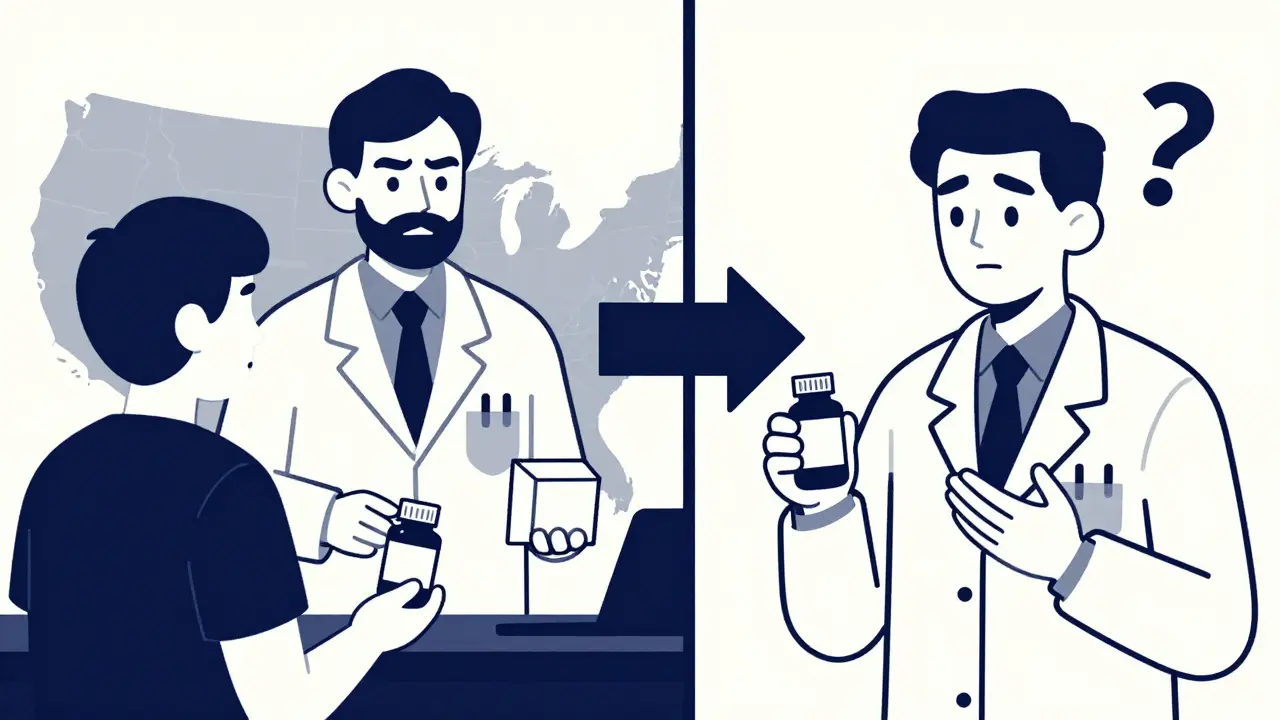
Have you ever picked up a prescription for a brand-name drug and walked out with a generic version instead? Or maybe you asked for the brand, but the pharmacist insisted on the generic? The answer to why this happens-and whether it’s optional or required-depends entirely on where you live. In the United States, pharmaceutical regulation is not a single federal rulebook. Instead, it is a patchwork of state laws that dictate when pharmacists can or must swap expensive brand-name medications for cheaper generic equivalents.
This distinction between mandatory and permissive substitution laws shapes healthcare costs, patient access, and even medication adherence. Understanding these differences is crucial for patients who want control over their prescriptions, pharmacists navigating legal requirements, and policymakers looking to reduce spending. Let’s break down how these laws work, which states fall into which category, and what this means for your next trip to the pharmacy.
What Is Drug Substitution?
Drug substitution occurs when a pharmacist dispenses a medication different from the one prescribed by the doctor, typically replacing a brand-name drug with a generic equivalent. This practice exists because generic drugs contain the same active ingredients, have the same dosage form, strength, route of administration, and intended use as their brand-name counterparts. They are also significantly cheaper, often costing 80-85% less than the original brand.
The foundation for modern generic drug approval was laid by the Hatch-Waxman Act of 1984. This federal law created a pathway for generic manufacturers to prove their products were bioequivalent to brand-name drugs without repeating costly clinical trials. However, while the FDA approves generics through its Orange Book, the decision to actually substitute them at the pharmacy counter is left to individual states. This decentralization has led to a highly fragmented regulatory landscape across the country.
Mandatory vs. Permissive Substitution Laws
The core difference lies in the level of obligation placed on the pharmacist. Under mandatory substitution laws, pharmacists are legally required to dispense a generic equivalent if one is available and appropriate, unless the prescriber explicitly prohibits it. In these states, substitution is the default action. If you write "Brand Medically Necessary" on the prescription, you stop the substitution; otherwise, the pharmacist must switch to the generic.
In contrast, permissive substitution laws authorize pharmacists to make substitutions but do not require them. Here, the pharmacist has professional discretion. They may choose to substitute based on cost-saving goals, insurance requirements, or personal judgment, but they are not compelled to do so by statute. This gives both the pharmacist and the patient more flexibility, but it also leads to inconsistent outcomes regarding generic utilization rates.
| Feature | Mandatory Substitution | Permissive Substitution |
|---|---|---|
| Pharmacist Obligation | Must substitute if generic is available | May substitute at professional discretion |
| Default Action | Generic dispensing | Varies by pharmacist/pharmacy policy |
| Prescriber Control | Must actively prohibit (e.g., "DAW") | Can prefer brand without strict prohibition |
| Impact on Costs | Higher generic utilization, lower costs | Lower generic utilization, higher variability |
| Example States | Alabama, Arizona, Colorado, Connecticut | California, Florida, Illinois, New York |
Current State Landscape: Who Requires What?
As of recent analyses, including a comprehensive cross-sectional study published in JAMA Internal Medicine, the U.S. regulatory map is divided. Approximately 19 states enforce mandatory substitution laws. These include Alabama, Alaska, Arizona, Arkansas, Colorado, Connecticut, Delaware, Idaho, Indiana, Kentucky, Louisiana, Maine, Maryland, Massachusetts, Mississippi, Montana, New Hampshire, North Dakota, and West Virginia. In these jurisdictions, the system is designed to push generic usage to its maximum potential automatically.
The remaining states operate under permissive frameworks. Notably, large population centers like California, Florida, Illinois, Michigan, New York, and Texas generally allow substitution but do not mandate it. This trend has shifted slightly over time; earlier studies in the 2010s identified fewer mandatory states, suggesting a gradual move toward stricter generic promotion in some regions. However, the majority of the country still relies on permissive models, creating a significant disparity in how medications are dispensed from coast to coast.

Key Regulatory Dimensions Beyond Mandates
It’s not just about whether substitution is mandatory or permissive. Several other factors influence how these laws function in practice:
- Patient Notification: Does the pharmacist need to tell you they swapped the drug? Thirty-one states plus Washington, D.C., require independent notification beyond just changing the label on the bottle. This ensures patients are aware of the change, which can be critical for those sensitive to inactive ingredients.
- Consent Protocols: Seven states plus D.C. require explicit patient consent before substituting. This adds a layer of patient autonomy but can slow down the process and reduce overall generic adoption rates.
- Liability Protections: Pharmacists worry about being sued if a substituted drug causes an adverse reaction. Currently, 24 states do not explicitly protect pharmacists from greater liability when substituting generics. This lack of clear protection can make pharmacists hesitant to substitute, even in permissive states.
- Formulary Systems: Some states use positive formularies (listing drugs that can be substituted) or negative formularies (listing drugs that cannot). Most rely on the FDA’s Orange Book designations to determine therapeutic equivalence.
Impact on Generic Utilization and Healthcare Costs
The real-world impact of these legal distinctions is stark. A Medicaid study by Shrank et al. examined simvastatin utilization after patent expiration. In states with mandatory substitution laws, 48.7% of prescriptions were filled with generics within six months. In permissive states, that number dropped to just 30.0%. That’s an 18.7 percentage point gap driven purely by regulatory structure.
When patient consent requirements are added to the mix, the effect is even more dramatic. States that did not require patient consent achieved 98.1% generic utilization for simvastatin, while those requiring consent saw less than one-third (32.1%) of prescriptions filled with generics. Given that generic drugs cost significantly less, these variations translate to billions of dollars in savings-or lost savings-for public health programs like Medicare and Medicaid. The Congressional Budget Office estimated that increasing generic use by just 1 percentage point could save Medicare Part D $160 million annually.

Biosimilars: A More Complex Frontier
While small-molecule generics have been around for decades, the rise of biologic medications and their cheaper counterparts, biosimilars, has introduced new complexity. Biologics are large, complex molecules derived from living organisms, making them harder to replicate exactly than traditional pills.
Consequently, state laws treat biosimilar substitution differently. According to the JAMA analysis, 45 states have more stringent requirements for interchangeable biologic substitution compared to small-molecule drugs. Common additional hurdles include mandatory physician notification and stricter recordkeeping mandates. Only nine states and D.C. have equivalent requirements for biologics as they do for traditional generics. This cautious approach reflects concerns about immunogenicity and the risks associated with switching between biologic products, highlighting a dual-track regulatory system that prioritizes safety over cost savings in high-value therapies.
Practical Implications for Patients and Prescribers
If you are a patient, understanding your state’s laws empowers you to advocate for your healthcare needs. In mandatory states, if you believe a specific brand is necessary due to past reactions or efficacy issues, you must clearly communicate this to your prescriber. Ask them to mark the prescription as "Dispense as Written" (DAW) or "Brand Medically Necessary." Without this notation, the pharmacist is legally bound to provide the generic.
For prescribers, especially those managing patients with narrow therapeutic index drugs (where small changes in concentration can lead to toxicity or treatment failure), knowing local substitution rules is vital. In states without explicit liability protections, prescribers may face pushback from pharmacists reluctant to substitute. Clear communication and proper documentation on the prescription pad are essential to ensure the patient receives the intended therapy.
Pharmacists, meanwhile, navigate a balancing act between cost-containment pressures, legal obligations, and patient care. In permissive states, they must exercise professional judgment, often consulting with insurers or formulary guidelines to decide when substitution is appropriate. In mandatory states, their role shifts to ensuring compliance with the law while monitoring for any adverse effects post-substitution.
Why do states have different substitution laws?
The Hatch-Waxman Act of 1984 established federal standards for generic drug approval but deliberately left the decision on substitution practices to state legislatures. This allows each state to tailor regulations to their specific healthcare priorities, balancing cost containment with patient choice and professional autonomy.
Can I refuse a generic drug if my state has mandatory substitution?
Yes, but you usually need to pay the price difference. While the pharmacist is required to substitute, you can request the brand-name drug. However, your insurance may not cover the extra cost, meaning you would be responsible for paying the full retail price of the brand.
What does "Dispense as Written" mean?
"Dispense as Written" (DAW) is a notation on a prescription that instructs the pharmacist to provide the exact brand-name drug prescribed, overriding any mandatory substitution laws. It is often used when a patient has had adverse reactions to generics or when clinical evidence suggests the brand is more effective for that specific individual.
Are biosimilars treated the same as generic drugs?
No. Biosimilars are subject to stricter substitution rules in most states. While generics are chemically identical to their brand counterparts, biosimilars are similar but not identical to reference biologics. Consequently, many states require additional steps like physician notification or explicit consent before substituting a biosimilar.
How do substitution laws affect healthcare costs?
Mandatory substitution laws significantly reduce healthcare costs by increasing generic utilization. Studies show that states with mandatory laws have much higher rates of generic filling, leading to substantial savings for patients, insurers, and government programs like Medicare and Medicaid.