
Imagine you've got a solid product on the market. Suddenly, you need to tweak how it's made-maybe new equipment, a different supplier, or a shift in facility location. For generic drug manufacturers, this isn't just an operational update; it's a regulatory event that can trigger months of scrutiny from the FDA is the U.S. Food and Drug Administration, responsible for protecting public health by ensuring the safety, efficacy, and security of drugs.. The core question is simple but critical: what specific manufacturing changes force the agency to re-evaluate your approved generic drug? Get this wrong, and you face delays, extra costs, or even rejection. Get it right, and you keep your supply chain agile without losing market share.
The answer lies in the Chemistry, Manufacturing, and Controls (CMC) framework established under the Abbreviated New Drug Application (ANDA) pathway. Since the Hatch-Waxman Act of 1984, generic manufacturers have relied on the innovator drug’s safety and effectiveness data, focusing instead on proving bioequivalence. But once approved, any change to the manufacturing process must not adversely affect the drug’s identity, strength, purity, or quality compared to the Reference Listed Drug (RLD). The current system is heavily shaped by the Generic Drug User Fee Amendments (GDUFA), specifically GDUFA III, which was reauthorized through 2027. This framework dictates how you classify changes and what evidence you must provide to prove they are safe and effective.
Understanding the Risk-Based Classification System
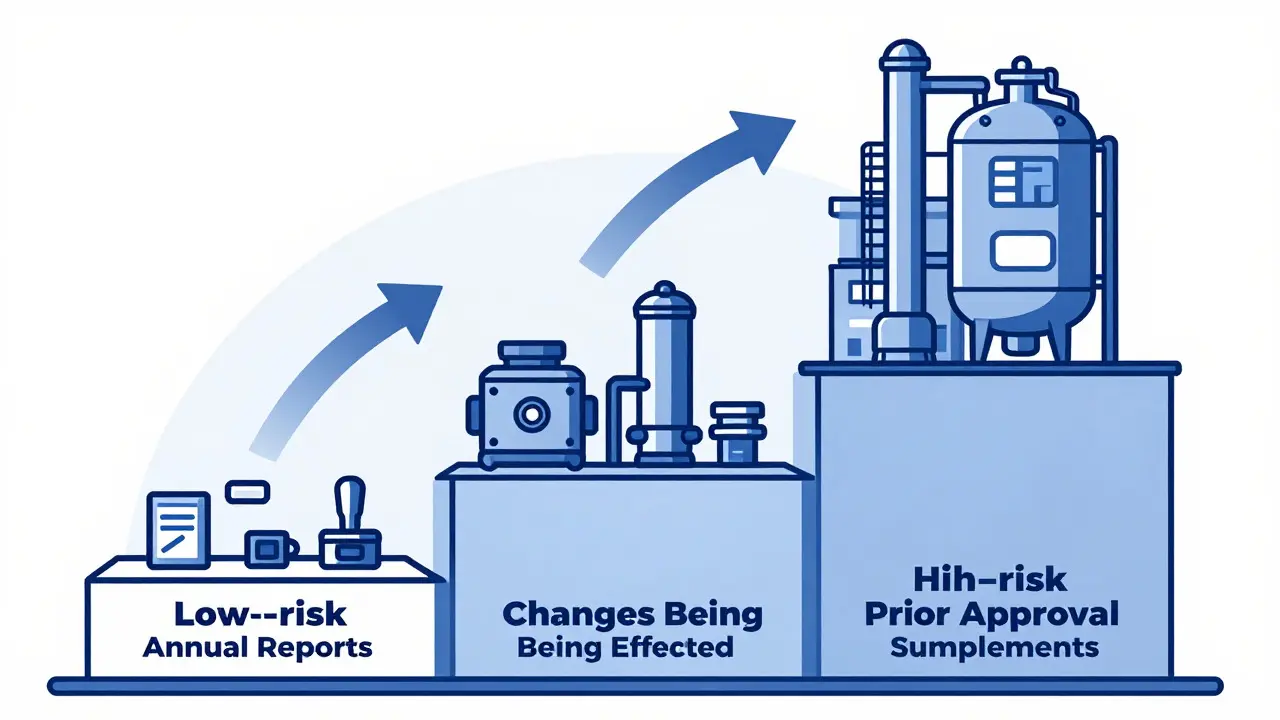
The FDA doesn’t treat all manufacturing changes equally. Instead, it uses a risk-based approach to categorize them into three distinct groups. Understanding where your change fits is the first step in avoiding unnecessary delays. These categories determine whether you need permission before making the change, can make the change while notifying the agency, or simply report it annually.
- Prior Approval Supplements (PASs): These are high-risk changes. You cannot implement them until the FDA approves the supplement. Examples include changing the manufacturing site, altering the synthetic route of the active ingredient, or significantly scaling up production. According to FDA data from 2018-2022, there was a 27.3% increase in major changes like PASs, driven by both intended improvements and unintended issues like supply chain disruptions.
- Changes Being Effected (CBEs): These are moderate-risk changes. You can implement the change immediately, but you must notify the FDA within a specific timeframe (either 30 days or 0 days). A CBE-30 requires notice 30 days after implementation, while a CBE-0 allows immediate notification. These often involve minor equipment adjustments or updates to in-process controls.
- Annual Reports (ARs): These are low-risk changes. You don’t need prior approval or immediate notification. You simply list these changes in your annual report to the FDA. Examples include minor packaging label changes or small adjustments to stability testing protocols that don’t impact the final product quality.
A 2023 survey published in Pharmaceutical Technology revealed that manufacturing process changes account for roughly 16% of all postapproval CMC submissions. This includes scale-up operations, equipment swaps, and new synthetic routes. The key takeaway here is that the classification isn't arbitrary; it’s based on the potential impact on the patient. If a change could theoretically alter the drug’s performance, it moves up the risk ladder.
Common Triggers for Full Re-evaluation
So, what actually triggers a full re-evaluation? It’s usually when the change has the potential to affect the drug’s bioavailability or impurity profile. Here are the most common scenarios that lead to a PAS submission:
- Facility Transfers: Moving production from one plant to another is a classic trigger. Even if the process stays the same, differences in water quality, air filtration, or local regulations can impact the product. In 2022, the Association for Accessible Medicines documented a case where a 30% increase in batch size for a solid oral dosage form required extensive process validation and six months of stability data, triggering a PAS that took 14 months to approve.
- Process Modifications: Changing the temperature, pH, or reaction time in the synthesis of the active pharmaceutical ingredient (API) can alter the impurity profile. For complex generics like peptides, the FDA mandates that any new specified peptide-related impurity must be less than 0.5%, with justification showing no impact on safety.
- Equipment Changes: Swapping out a tablet press or a mixing vessel might seem minor, but if the new equipment operates differently, it can affect particle size distribution or mixing uniformity. One Reddit user in r/pharmaceuticals noted a case where a tablet press upgrade took 18 months to approve despite identical product quality metrics, highlighting the scrutiny involved.
- Supplier Changes: Switching API suppliers is a frequent trigger. Even if the chemical structure is identical, subtle differences in crystal form or residual solvents can require re-testing. This is particularly relevant for domestic sourcing initiatives, where companies are shifting suppliers to reduce supply chain risks.
The FDA’s 2023 Generic Drug Program Report showed that 68.4% of PAS submissions for manufacturing changes required at least one complete response letter. Analytical method changes (28.7%), facility transfers (24.5%), and formulation changes (19.3%) were the top reasons for additional information requests. This means that if you’re planning a change, you should anticipate back-and-forth communication with reviewers.
The Cost and Time of Navigating Regulatory Hurdles
Time is money in the generic drug market. The average review timeline for a PAS is about 10 months, compared to just 3 months for a CBE-30. However, complex changes can extend this significantly. Industry data from 2023 suggests that the cost of submitting a PAS averages $287,500 per submission. For low-margin generic products, this cost can outweigh the benefits of the manufacturing improvement, leading to what some experts call "regulatory paralysis."
Dr. Jane Smith, former FDA Office of Generic Drugs director, stated in a 2022 Journal of Generic Medicines article that improved process understanding during development can reduce post-approval CMC changes by up to 40%. This highlights the importance of Quality by Design (QbD) principles. By establishing a robust design space during the initial ANDA development, manufacturers can accommodate future changes without triggering full re-evaluations. Companies employing advanced process analytical technology (PAT) reported 32.6% fewer PAS submissions over a five-year period compared to traditional manufacturers.
| Supplement Type | Risk Level | Timing of Submission | Average Review Time | Typical Examples |
|---|---|---|---|---|
| Prior Approval Supplement (PAS) | High | Before implementation | ~10 months | Site transfer, new synthetic route, major scale-up |
| Change Being Effected (CBE-30) | Moderate | Within 30 days after implementation | ~3 months | Minor equipment change, updated specifications |
| Annual Report (AR) | Low | In annual report | N/A (No individual review) | Label changes, minor stability protocol updates |
Strategies to Minimize Re-evaluation Risks
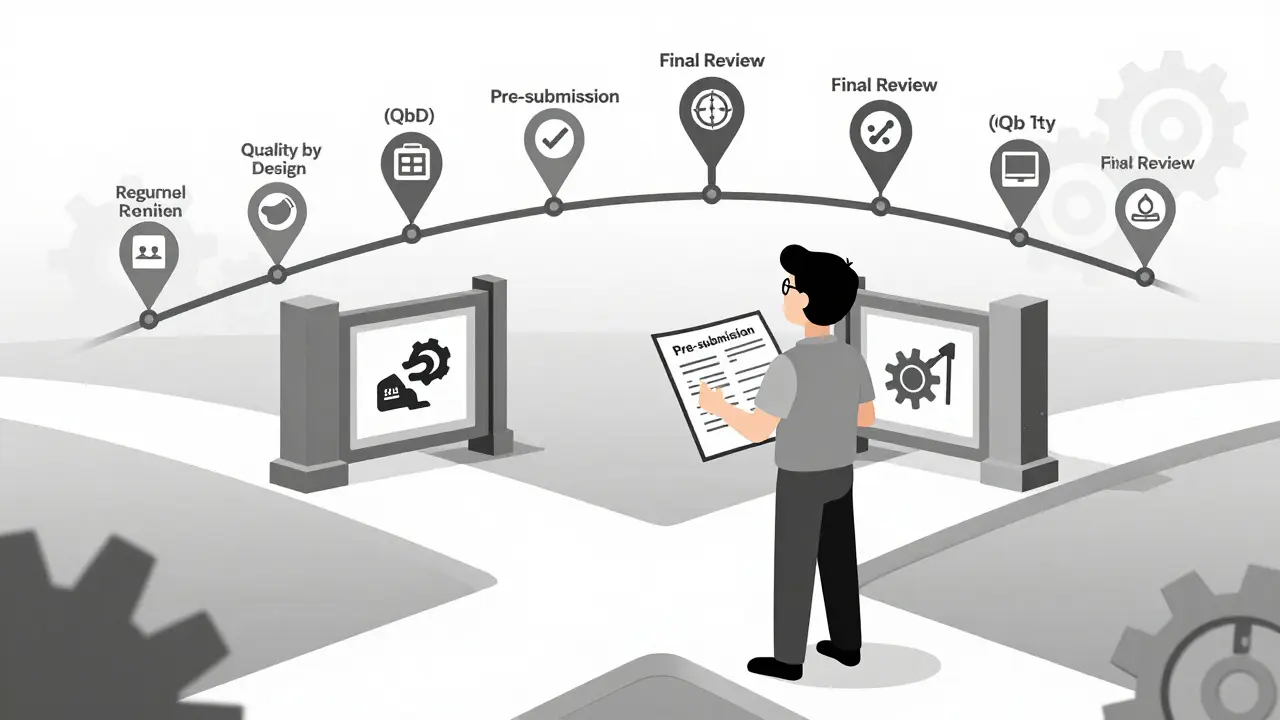
You don’t have to accept long delays as inevitable. Strategic planning can significantly reduce the burden of post-approval changes. Here are practical steps to consider:
- Invest in Process Characterization: Understand your process deeply. If you know exactly how variables affect quality, you can justify changes more easily. Sandoz and Mylan demonstrated that companies with mature quality management systems reduced PAS approval timelines by 31.4% through proactive risk assessment.
- Leverage Pre-submission Meetings: For complex changes, schedule 3-5 pre-submission meetings with the FDA. Teva Pharmaceuticals successfully implemented continuous manufacturing for amlodipine in 2022, reducing PAS review time to 8 months through extensive pre-submission discussions and comprehensive comparative analytics.
- Utilize Expedited Pathways: The FDA’s September 2023 ANDA Prioritization Pilot Program accelerates reviews for generics with US-based manufacturing and domestic API sources. This program offers potential approval within 8 months compared to the standard 30-month average for new approvals, though it primarily targets new applications rather than supplements, it signals a broader push for efficiency.
- Monitor Guidance Updates: The FDA released a draft guidance in January 2024 proposing a tiered risk assessment framework for complex generic drug products. This could reduce PAS submissions for minor changes to complex products by up to 35%. Staying updated on such drafts helps you align your strategies with future regulatory expectations.
Small manufacturers often face longer review times. A 2023 survey found that companies with fewer than 5 ANDAs experienced 43% longer review times than large manufacturers with over 20 ANDAs. This disparity often stems from limited resources for preparing robust submissions. Building internal expertise or partnering with regulatory consultants can help bridge this gap.
Market Dynamics and Future Outlook
The generic drug market is valued at $113.7 billion in the US, facing intense price competition. This pressure discourages investment in manufacturing improvements that require costly PAS submissions. However, recent FDA initiatives are reshaping this landscape. Commissioner Robert Califf stated at the October 2023 public meeting that faster reviews for domestically manufactured generics could reduce supply chain vulnerabilities by incentivizing $4.2 billion in new US manufacturing investments by 2027.
Industry analysts project that by 2026, 37.5% of new generic approvals will qualify for expedited pathways. Additionally, the FDA’s PreCheck program, announced in February 2024, introduces a two-phase approach to accelerate approval of high-priority manufacturing facilities, potentially cutting facility transfer timelines from 18 months to 9 months. Long-term assessments by McKinsey & Company suggest that manufacturers adopting advanced manufacturing technologies could reduce post-approval change-related revenue losses by $8.7 billion annually across the generic industry by 2030.
As you navigate these waters, remember that the goal isn’t just compliance-it’s maintaining a competitive edge. By understanding the triggers for re-evaluation and proactively managing your manufacturing processes, you can turn regulatory hurdles into opportunities for innovation and efficiency.
What is the difference between a PAS and a CBE?
A Prior Approval Supplement (PAS) requires FDA approval before you can implement the change, whereas a Change Being Effected (CBE) allows you to implement the change first and then notify the FDA within a set timeframe (30 days or immediately). PAS is for high-risk changes, while CBE is for moderate-risk changes.
How long does it take to get FDA approval for a manufacturing change?
The average review time for a Prior Approval Supplement (PAS) is about 10 months. However, complex changes can take longer, sometimes exceeding 14 months. CBE-30 supplements typically take around 3 months for review, and Annual Reports do not undergo individual review.
Does changing the API supplier always require a new application?
Not always, but it often triggers a supplement. If the new supplier provides an API with identical quality attributes, it might be a lower-risk change. However, if there are differences in impurities, polymorphs, or residual solvents, it may require a PAS with comparative data to prove equivalence.
What is GDUFA III and how does it affect manufacturing changes?
GDUFA III is the latest reauthorization of the Generic Drug User Fee Amendments, valid through 2027. It sets the fee structure and performance goals for the FDA’s generic drug program. While it doesn’t change the scientific requirements for CMC changes, it influences the speed and predictability of the review process, aiming for more consistent timelines.
Can I avoid a PAS by using Quality by Design (QbD)?
Yes, partially. If you establish a robust design space during your initial ANDA approval using QbD principles, certain changes within that space may not require a PAS. This allows for flexibility in manufacturing parameters without triggering full re-evaluation, provided the changes stay within the validated boundaries.