Opioid-Induced Respiratory Risk Estimator
Click to select applicable factors:
Current Risk Level
0%
You take your pain medication at night. You expect to sleep. But for millions of people, that routine hides a silent killer. The combination of opioids and sleep apnea creates a perfect storm for respiratory depression, a condition where your brain simply forgets to tell your lungs to breathe. It is not just about snoring or waking up tired. It is about the mechanical failure of your body’s most automatic function.
According to the Centers for Disease Control and Prevention (CDC), respiratory depression accounts for approximately 70% of all opioid overdose deaths. That number is staggering. It means that in seven out of ten fatal cases, the person did not necessarily take a massive dose by accident; their body’s natural safety brakes failed while they slept. If you are on long-term pain management, understanding this interaction is not optional-it is a matter of survival.
How Opioids Silence Your Brain’s Breathing Alarm
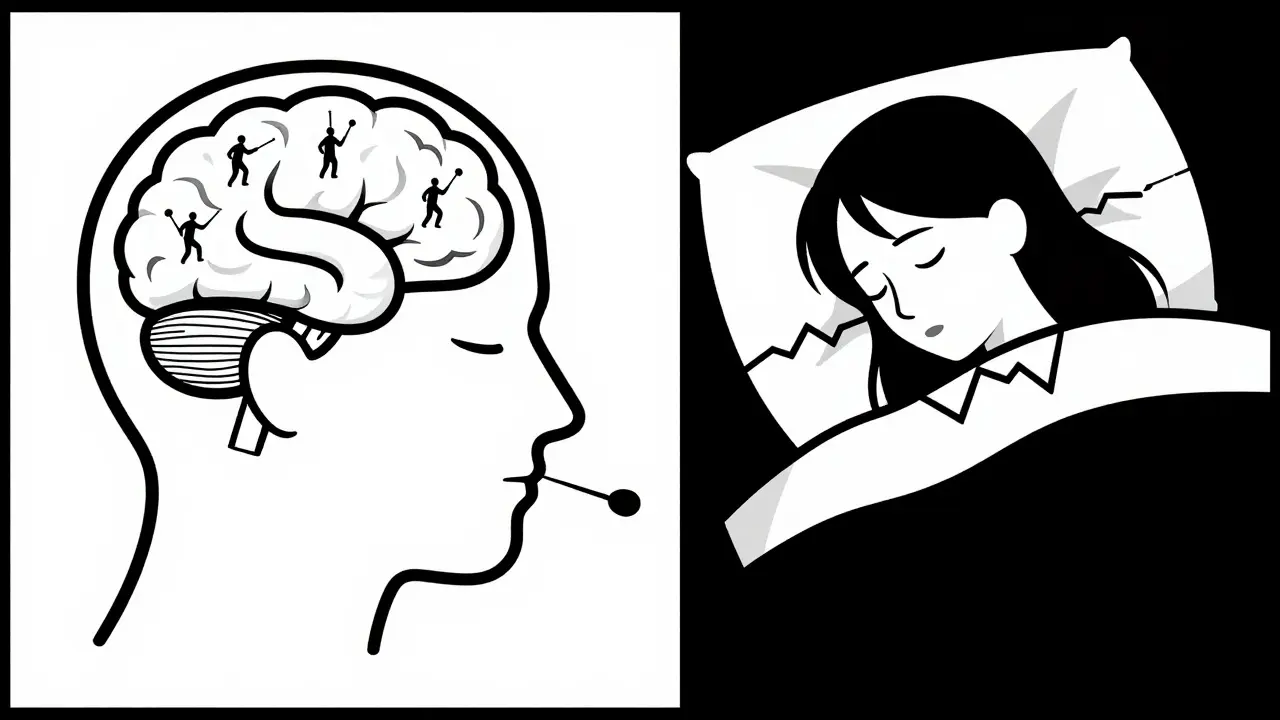
To understand why this happens, we have to look inside the brainstem, specifically at two tiny but critical regions: the parabrachial complex and the pre-Bötzinger complex. Think of these areas as the conductors of an orchestra. They send signals to keep your diaphragm moving rhythmically, whether you are awake or asleep.
When you introduce opioids into this system, they bind to mu-opioid receptors (MOR). This binding doesn’t just dull pain; it disrupts the conductor’s baton. Research from Harvard Medical School and Beth Israel Deaconess Medical Center (2023) shows that opioids cause the parabrachial complex to enhance "tonic expiratory drive." In plain English, this means your body holds its breath longer during exhalation. Studies show expiration time can increase by 100-200%, while inspiration only increases slightly. The result? Long pauses between breaths, known as apneas.
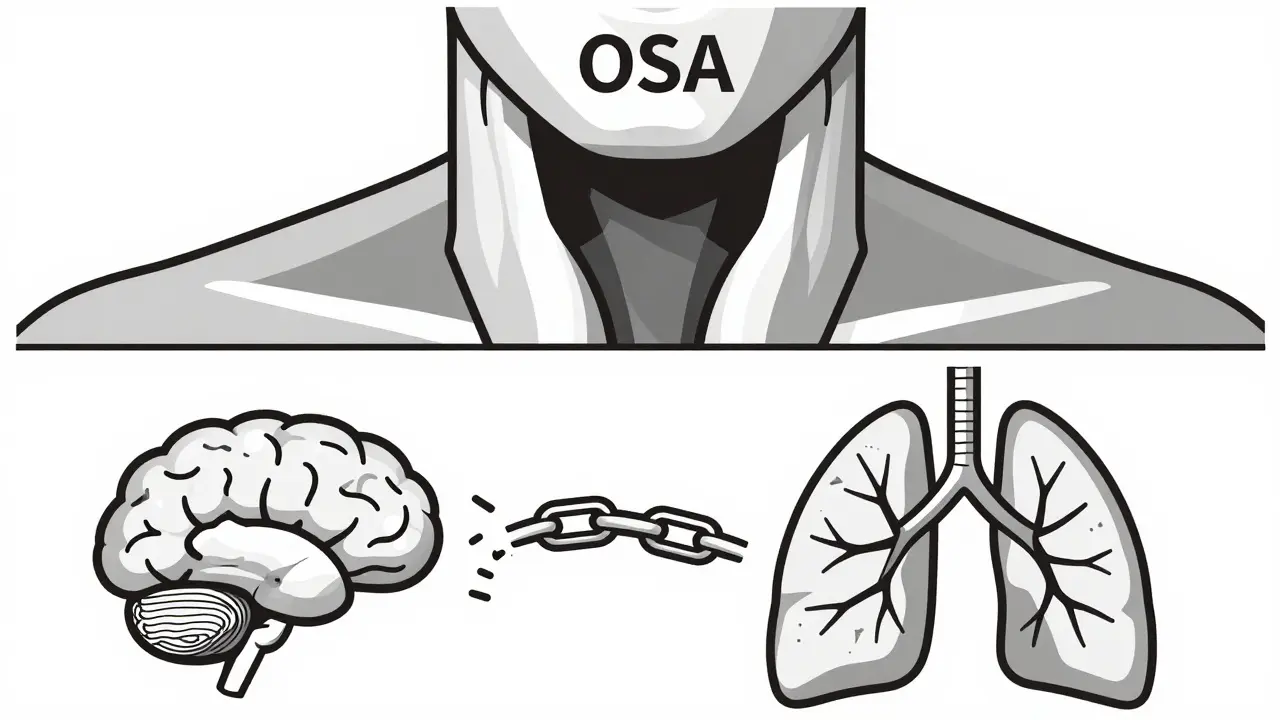
It gets worse when you add sleep apnea to the mix. People with obstructive sleep apnea already struggle with airway collapse. Opioids make this worse by suppressing the muscles that keep your throat open. Specifically, opioids reduce the output to the genioglossus muscle-the main dilator of your upper airway-by 40-60%. So, your airway collapses mechanically, and your brain fails to wake you up to fix it because the respiratory drive is suppressed. You are trapped in a cycle of suffocation without the usual alarm bells ringing.
The Hidden Danger: Central vs. Obstructive Apnea
Most people know obstructive sleep apnea (OSA), where the throat physically blocks airflow. But opioids create a different beast: central sleep apnea (CSA). In CSA, the airway is open, but the brain stops sending the signal to breathe entirely.
| Feature | Obstructive Sleep Apnea (OSA) | Central Sleep Apnea (CSA) / Opioid-Induced |
|---|---|---|
| Cause | Physical blockage of airway | Brain fails to signal breathing muscles |
| Opioid Impact | Worsens due to muscle relaxation | Directly caused by receptor suppression |
| Detection Difficulty | Easier (loud snoring/gasping) | Harder (silent pauses, no gasping) |
| Risk Factor | Anatomy, weight, age | Dose-dependent, genetic susceptibility |
This distinction matters because standard treatments for OSA, like CPAP machines, might not fully protect you if the issue is central. If your brain isn’t telling you to breathe, positive pressure alone may not be enough to trigger the necessary respiratory effort. Patients on high-dose opioids (≥100 morphine milligram equivalents daily) show an average apnea-hypopnea index (AHI) of 15.7 events per hour, compared to just 4.2 in non-users. For some, this spikes above 30, which is considered severe and life-threatening.
Who Is Most at Risk?
Not everyone reacts the same way. Genetics play a surprising role. Variations in the OPRM1 gene determine how sensitive your mu-opioid receptors are. Some people are naturally less responsive to carbon dioxide buildup in the blood-a condition called blunted hypercapnic response. About 10-15% of the population has this trait. For them, adding opioids is exponentially more dangerous because their primary backup alarm (high CO2 levels triggering breath) is already weak.
Other major risk factors include:
- Combining medications: Mixing opioids with benzodiazepines (like Xanax or Valium) increases overdose risk by 300-500%. Both drug classes suppress the central nervous system, creating a synergistic effect that shuts down breathing faster than either drug alone.
- Sleep architecture disruption: Opioids reduce slow-wave sleep by 20-30% and increase light sleep. This fragmented sleep state makes it harder for the brain to stabilize breathing patterns.
- High doses: The risk is dose-dependent. As the dose rises, the suppression of the pre-Bötzinger complex becomes more profound, leading to longer apneic episodes.
Warning Signs You Should Not Ignore
Your body tries to tell you something is wrong, but the symptoms are often mistaken for side effects or poor sleep hygiene. Do not dismiss these signs:
- Morning headaches: Caused by chronic hypoxemia (low oxygen) and hypercapnia (high carbon dioxide) overnight.
- Excessive daytime sleepiness: Even after 8 hours in bed, you feel exhausted because your sleep was interrupted hundreds of times by micro-arousals.
- Witnessed apneas: A partner reports seeing you stop breathing or gasping for air.
- Confusion or brain fog: Resulting from poor oxygen delivery to the brain during deep sleep cycles.
If you experience these, especially after starting or increasing an opioid dose, seek medical evaluation immediately. Standard pulse oximeters worn on the finger can be misleading. Oxygen saturation often stays normal until the very end of an apneic event due to compensatory mechanisms. By the time your numbers drop, significant damage may already be occurring.
Safety Strategies and Monitoring
You do not have to live in fear, but you must live with awareness. Here are actionable steps to mitigate risk:
1. Get Screened
The American Society of Anesthesiologists recommends baseline sleep studies for patients on long-term opioid therapy. If you haven’t had one, ask your doctor. A polysomnography test can distinguish between obstructive and central apnea, guiding proper treatment.
2. Avoid Sedative Combinations
Be ruthless about avoiding alcohol and benzodiazepines while on opioids. If anxiety or insomnia is keeping you up, talk to your doctor about non-sedating alternatives. The margin for error shrinks drastically when you mix depressants.
3. Use Naloxone Wisely
Naloxone is the antidote for opioid overdose. Keep it accessible. However, note that naloxone has a narrow therapeutic window. Too little won’t reverse the depression; too much can precipitate acute withdrawal, which is traumatic and risky. Standard emergency dosing is 0.04-0.4 mg intravenously, repeated every 2-3 minutes. For home use, nasal sprays are widely available. Educate family members on how to use it.
4. Consider Advanced Monitoring
In hospital settings, continuous capnography is used for high-risk patients. While not always available at home, newer consumer-grade devices monitor respiration rate and movement more accurately than simple pulse oximeters. Discuss options with your provider if you are on high doses.
5. Explore Alternative Therapies
Research is advancing rapidly. New biased agonists are being developed that target pain pathways without heavily engaging the respiratory centers in the brainstem. Early models show 70-80% pain relief with only 20-30% of the respiratory depression seen with traditional opioids. Ask your specialist if clinical trials or newer formulations are appropriate for your case.
Conclusion: Knowledge Is Protection
The intersection of opioids and sleep apnea is complex, but it is manageable with vigilance. Understanding that your brain’s breathing control center can be silenced helps you take proactive steps. Regular screening, avoiding sedative combinations, and recognizing early warning signs can mean the difference between a safe night’s rest and a medical emergency. Your pain deserves relief, but not at the cost of your breath.
Can opioids cause sleep apnea even if I didn't have it before?
Yes. Opioids can induce central sleep apnea by suppressing the brain's drive to breathe. They also worsen existing obstructive sleep apnea by relaxing throat muscles. Approximately 30-40% of chronic opioid users develop clinically significant sleep-disordered breathing.
Is it safe to use CPAP if I take opioids?
CPAP can help with obstructive components, but it may not fully address central apnea caused by opioids. Since opioids suppress the neural drive to breathe, CPAP alone might not trigger the necessary respiratory effort. Consult a sleep specialist to determine if adaptive servo-ventilation (ASV) or other therapies are needed.
What are the first signs of opioid-induced respiratory depression?
Early signs include slowed breathing rate, prolonged pauses between breaths, morning headaches, excessive daytime sleepiness, and confusion. In severe cases, blue tinting of lips or fingertips (cyanosis) occurs, indicating low oxygen levels.
Does mixing opioids with benzos really increase death risk that much?
Yes. CDC data indicates that combining opioids with benzodiazepines increases overdose risk by 300-500%. Both drugs depress the central nervous system, leading to additive or synergistic suppression of breathing and consciousness.
Are there safer opioid alternatives for pain management?
Research is focusing on biased agonists that separate analgesia from respiratory depression. Additionally, non-opioid pain management strategies, such as certain antidepressants, anticonvulsants, and physical therapy, can reduce reliance on opioids. Always discuss alternative pain plans with your healthcare provider.


Comments (9)