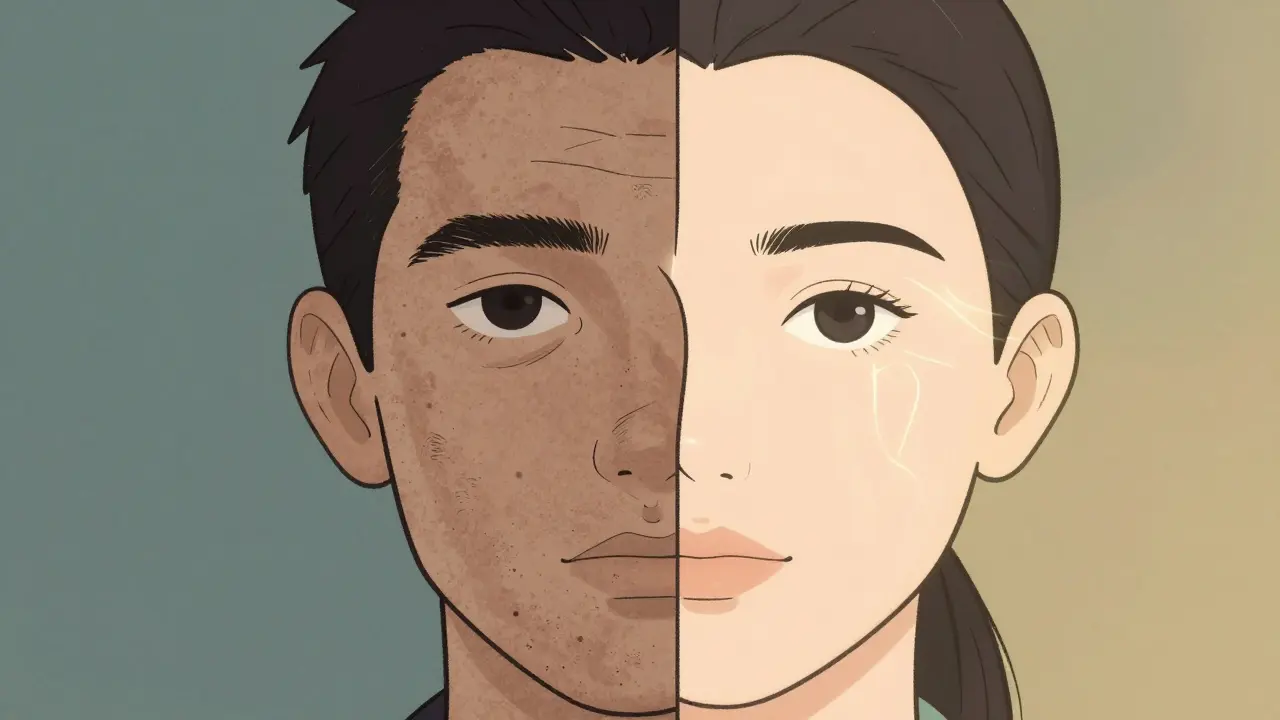
Most people think retinoids are just for acne. But if you’re seeing fine lines, uneven texture, or dark spots, they might be the most effective thing you’ve never tried. Tretinoin and adapalene aren’t just skincare ingredients-they’re the backbone of evidence-based skin repair. Both are retinoids, meaning they’re derived from vitamin A, but they work differently, suit different skin types, and deliver results at different speeds. Choosing between them isn’t about which is "better." It’s about which one fits tretinoin your skin right now.
What Tretinoin Actually Does to Your Skin
Tretinoin is the original prescription retinoid. It’s been used since the 1970s, and it’s still the gold standard for reversing sun damage. It doesn’t just treat acne-it rebuilds skin from the inside out. Tretinoin penetrates deep into the dermis, where it boosts collagen production, thickens the skin, and speeds up cell turnover. That’s why it fades dark spots, smooths wrinkles, and tightens pores over time. You won’t see results in a week. In fact, most people notice changes after 8 to 12 weeks. A 24-week study showed 0.05% tretinoin cream improved fine wrinkles by 42% and reduced mottled pigmentation by 58%. That’s not magic. That’s biology. But here’s the catch: tretinoin is harsh. It breaks down in sunlight and air, which is why it comes in dark tubes and must be applied at night. It also causes dryness, peeling, and redness in up to 92% of users during the first few weeks-a phase called "retinization." The good news? Formulations have improved. Retin-A Micro uses microspheres to release tretinoin slowly, cutting irritation by nearly half. Altreno, a newer 0.05% lotion, was approved in 2022 and showed 35% less irritation than traditional tretinoin while working just as well. If you’re serious about anti-aging and can handle the ramp-up, tretinoin is still the most powerful tool available.Why Adapalene Is the Easier Entry Point
Adapalene is the quieter cousin. Developed in the 1990s and made available over-the-counter in 2016, it’s become the go-to for beginners. Unlike tretinoin, adapalene doesn’t dive deep into the dermis. It works mostly in the epidermis-the top layer-where it unclogs pores, reduces inflammation, and prevents new breakouts. It’s not as strong for wrinkles, but it’s incredibly effective for acne. A 2021 review found that 0.1% adapalene reduces acne lesions by 69-74% after 8 weeks, matching the results of 0.025% tretinoin. But here’s the kicker: it causes far less irritation. In clinical trials, only 15% of adapalene users had redness compared to 32% with tretinoin. Scaling and stinging dropped by over half. That’s why dermatologists recommend it as a first-line treatment for sensitive skin. It’s also stable. Adapalene doesn’t break down in light or air, so you can use it with benzoyl peroxide (like in Epiduo) without worrying about degradation. That’s huge-combining them boosts acne clearance to 81% in 12 weeks. And because it’s OTC, you can buy Differin Gel for under $15. Prescription tretinoin? Around $45 without insurance. For most people starting out, adapalene gives you 80% of the results with 30% of the side effects.When to Choose Tretinoin Over Adapalene
If your main goal is anti-aging-deep wrinkles, loose skin, sun spots-tretinoin is the winner. A 2004 study in the Archives of Dermatology found that after 48 weeks, tretinoin improved pigmentation by 58%, while adapalene 0.3% only managed 47%. Adapalene can help with surface dullness, but it won’t remodel the dermis. If you’ve tried adapalene for 6 months and your fine lines haven’t budged, it’s time to switch. Tretinoin also outperforms adapalene in treating moderate to severe inflammatory acne. If you’re getting cysts or nodules, adapalene alone may not be enough. Dermatologists often pair tretinoin with antibiotics or oral medications for stubborn cases. And if you’re over 35, your skin’s natural collagen production is slowing. Tretinoin directly counters that. But don’t jump straight to tretinoin if you’ve never used a retinoid. The irritation can be brutal. Many people quit after two weeks because they weren’t prepared. Start with adapalene. Build tolerance. Then, if you’re ready, talk to your doctor about switching to tretinoin.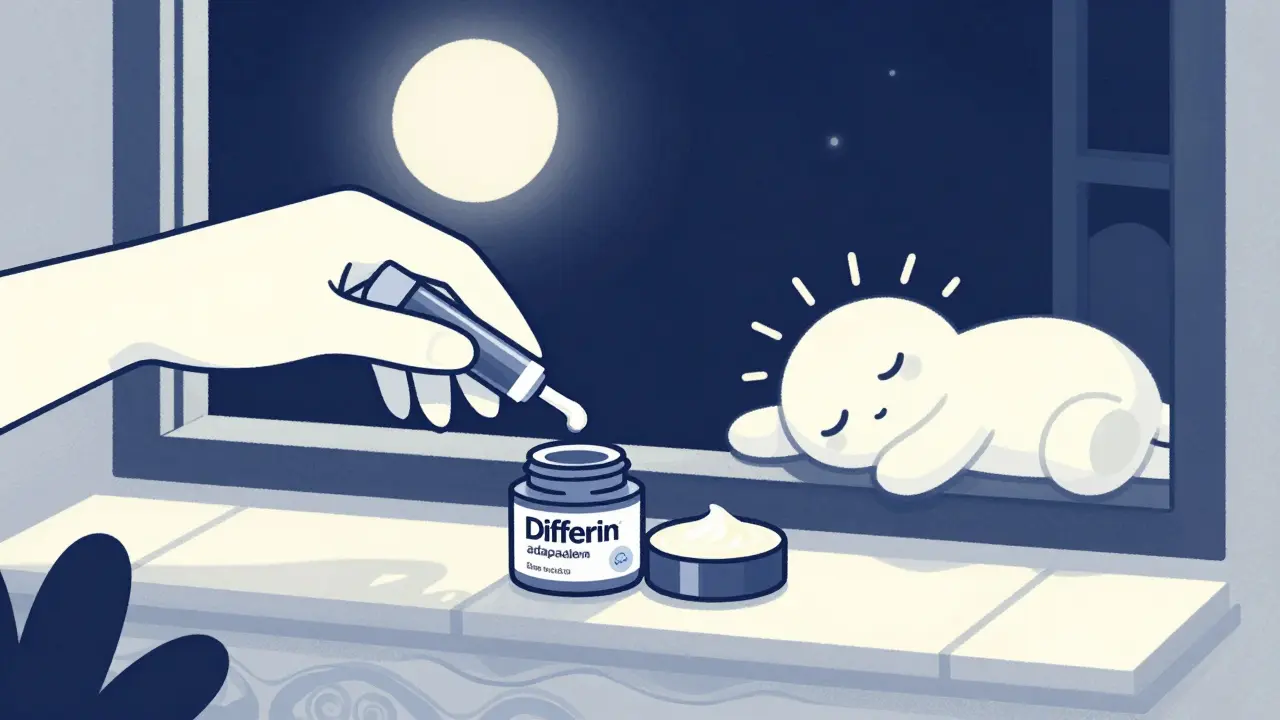
When Adapalene Is Enough-and When It’s Not
Adapalene shines for mild to moderate acne, especially if your skin is reactive. It’s perfect for teens, young adults, or anyone with rosacea-prone skin. Reddit users consistently report: "I switched from tretinoin to Differin and stopped peeling. My skin cleared up in 8 weeks." But here’s the limit: adapalene won’t fix deep wrinkles, sagging, or significant hyperpigmentation. One Amazon reviewer put it bluntly: "Differin cleared my acne but didn’t touch my wrinkles." If you’re using adapalene and your skin looks better but still feels thin or dull, you’re hitting a plateau. That’s not failure-it’s a signal. Your skin needs deeper action. That’s where tretinoin comes in. Also, don’t assume OTC means "weaker." The 0.3% prescription strength of adapalene is stronger than the 0.1% OTC version and performs closer to tretinoin in clinical studies. But even at 0.3%, it’s still not a dermal remodeler. Think of it like a scrub versus a chemical peel. One cleans the surface. The other restructures the foundation.How to Use Them Without Ruining Your Skin
The biggest reason people fail with retinoids? They use them wrong. Start slow. Use a pea-sized amount for your entire face-no more. Apply it 2-3 nights a week at first. Don’t go daily. Let your skin adjust. Wait 20 minutes after washing your face to apply it. Wet skin increases irritation. Use the "sandwich method": moisturizer, then retinoid, then moisturizer again. A 2022 trial showed this cuts irritation by 47%. If you’re using adapalene, you can apply it in the morning (it’s light-stable), but tretinoin must go on at night. And always, always wear SPF 30+ every day. Retinoids make your skin 3.2 times more vulnerable to sun damage. Expect a purge. For the first 2-6 weeks, you might get more breakouts. That’s your skin shedding clogged pores. Don’t panic. Stick with it. Studies show 87% of people who make it past 12 weeks see major improvement. Don’t combine with harsh scrubs, AHAs, or BHAs at first. Wait until your skin is calm. And never use retinoids if you’re pregnant or trying to get pregnant-they’re Category C, meaning they can harm a developing fetus.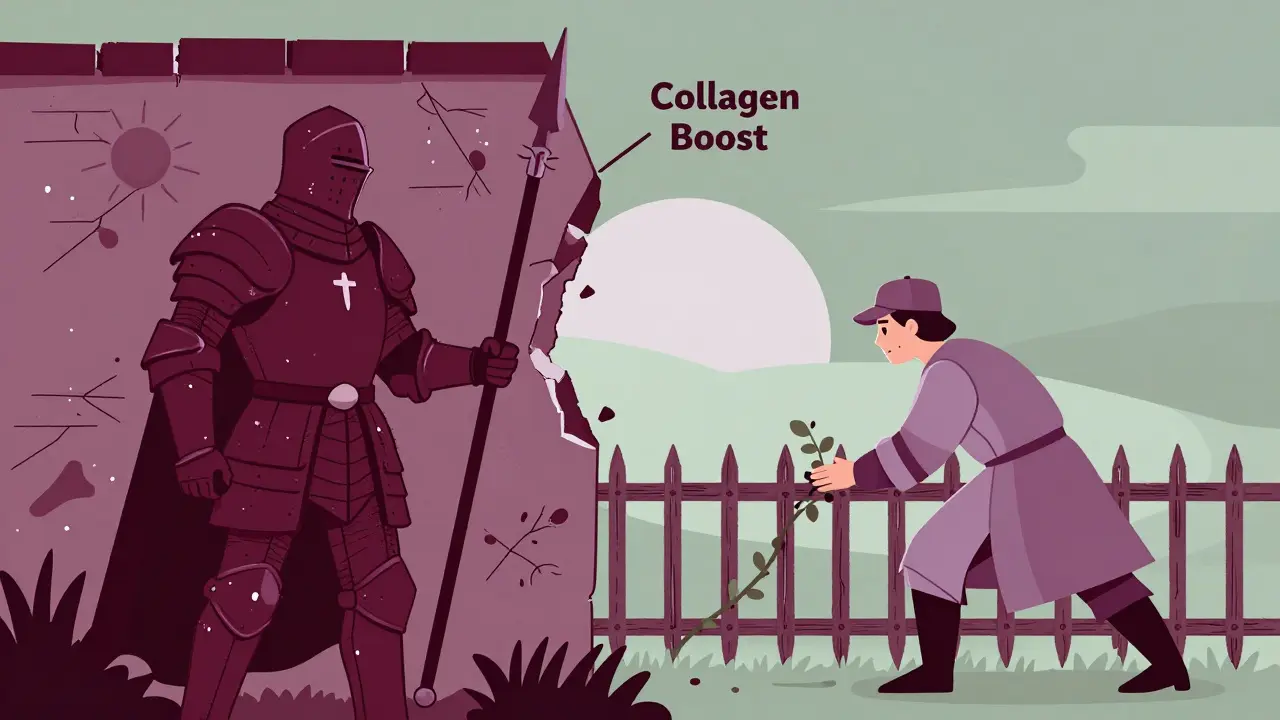


Comments (12)