
You’ve been prescribed a new medication. You walk into the pharmacy, hand over the card, and expect to pay your usual copay. Instead, the pharmacist tells you the drug isn’t covered, or worse, it’s on a higher tier that will cost you twice as much. It feels like a betrayal. But this isn’t random chaos-it’s how drug formularies work.
A drug formulary is simply the list of medications your health insurance plan agrees to cover. Think of it as a menu: if the doctor orders something off-menu, you might have to pay full price. Understanding this list is the single most effective way to control your healthcare costs. In 2026, with prescription spending continuing to rise, knowing where your drugs sit on this list can save you hundreds-or even thousands-of dollars a year.
How Formularies Are Built and Who Decides
Formularies aren’t created by a committee of bureaucrats guessing in the dark. They are developed by Pharmacy Benefit Managers (PBMs), the middlemen between insurers and pharmacies, in collaboration with Pharmacy and Therapeutics (P&T) committees. These committees are made up of real doctors and pharmacists who review clinical data, safety reports, and cost-effectiveness studies.
The goal is to balance two things: giving patients access to safe, effective medicines while keeping premiums affordable for everyone. When a new drug comes out, the P&T committee asks hard questions. Is it better than what we already have? Is the extra cost worth the benefit? If the answer is no, it might be placed on a higher tier or excluded entirely. This process happens quarterly, meaning the list changes regularly. As of 2023, virtually all private insurance plans, Medicare Part D, and Medicaid programs use these standardized lists.
Decoding the Tier System: Why Your Copay Varies
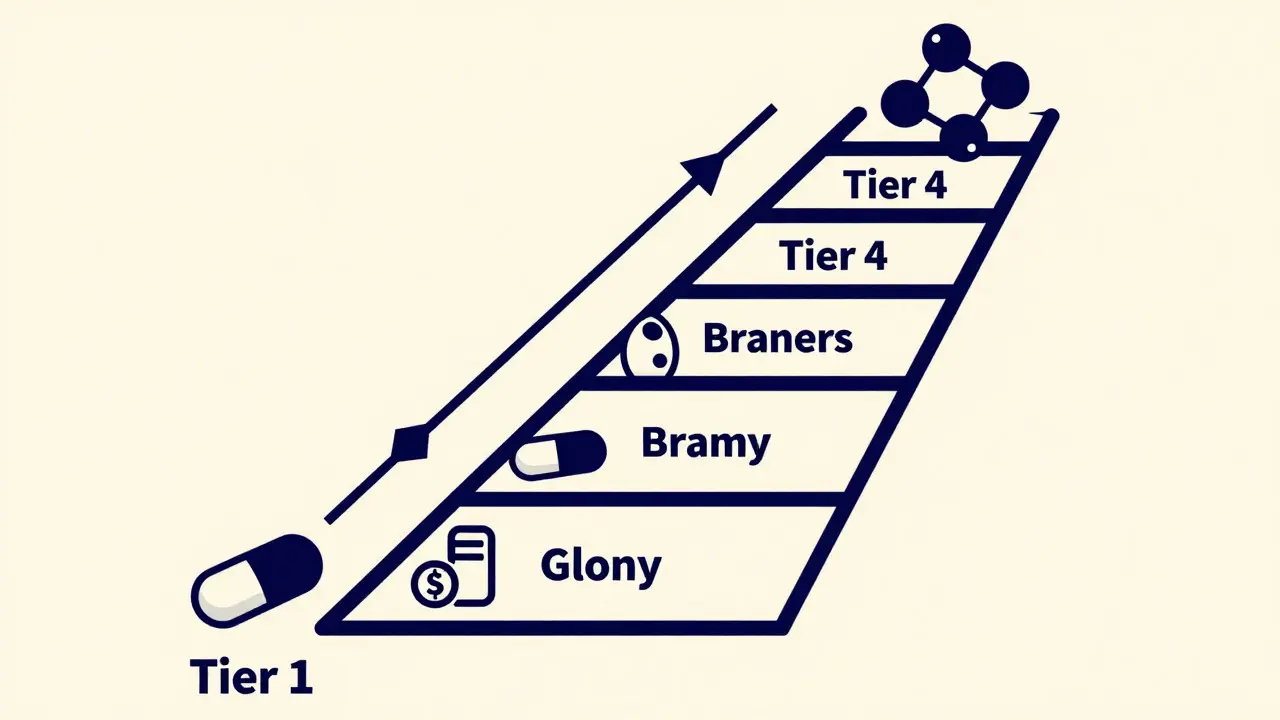
This is where most patients get confused. Why does one pill cost $5 and another $100? The answer lies in the insurance tiers. Most plans divide their formulary into 3 to 5 tiers. Each tier represents a different level of cost-sharing.
| Tier | Type of Drug | Estimated Patient Cost (30-day supply) |
|---|---|---|
| Tier 1 | Generic Medications | $0 - $10 |
| Tier 2 | Preferred Brand-Name | $25 - $50 (or 15-25% coinsurance) |
| Tier 3 | Non-Preferred Brand-Name | $50 - $100 (or 25-35% coinsurance) |
| Tier 4 | Specialty Medications | $100+ (or 30-50% coinsurance) |
Tier 1 is almost always generic drugs. The FDA requires generics to be identical to brand-name drugs in strength, safety, and performance. This is why insurers push them-they work just as well but cost a fraction of the price. Tier 2 includes preferred brand-name drugs. These are usually brands where the insurer has negotiated a good deal. Tier 3 contains non-preferred brands. Maybe the manufacturer refused to lower prices, or there’s a cheaper alternative available. Tier 4 is for specialty drugs used for complex conditions like cancer, rheumatoid arthritis, or multiple sclerosis. These are expensive to make and administer, so your share of the cost is higher.
Keep in mind that "preferred" doesn’t mean "better." It means "cheaper for this specific insurance plan." A drug might be Tier 2 on Blue Cross but Tier 3 on Aetna. Always check your specific plan’s formulary.
Navigating Restrictions: Prior Authorization and Step Therapy
Even if a drug is on the formulary, you might not get it immediately. Insurers use tools called utilization management strategies to ensure drugs are used appropriately. Two of the most common-and frustrating-are prior authorization and step therapy.
Prior authorization means your doctor must call or submit paperwork to prove you need this specific drug before the insurance pays for it. This often happens for expensive specialty drugs or controlled substances. It’s not a denial; it’s a checkpoint. If your doctor provides the right clinical justification, coverage is usually approved within 72 hours (or 24 hours for urgent cases).
Step therapy is stricter. It forces you to try a lower-cost, first-line treatment before the insurer will cover the more expensive option. For example, if you’re prescribed a high-cost biologic for psoriasis, the insurer might say, "Try the generic topical cream first. If it fails after three months, then we’ll cover the injection." Critics argue this delays care, but insurers argue it prevents unnecessary spending on drugs that might not be needed. According to a 2023 survey, 42% of patients had switched medications because of these requirements.
Another restriction is quantity limits. This caps how many pills you can fill at once. If you take a daily vitamin or a maintenance med, the limit might be a 30-day supply. If you need more, you have to justify it medically.
What Happens If Your Drug Isn’t Covered?
If your prescribed medication is "non-formulary," you face two choices: pay cash (which can be astronomical) or switch drugs. But there is a third option: a formulary exception.
You can ask your insurance company to cover a non-formulary drug or waive a step therapy requirement. To do this, your doctor must write a letter explaining why the formulary alternatives won’t work for you. Common reasons include severe side effects from other drugs or a history of treatment failure. In 2023, about 67% of these exceptions were approved in Medicare Part D plans.
The process takes time. Standard requests take up to 72 hours. If your health is at immediate risk, ask for an expedited review, which must be decided within 24 hours. Don’t assume the first "no" is final. Appeal if necessary. The American Medical Association emphasizes that while formularies manage costs, they must balance financial concerns with individual patient needs through accessible exception processes.

Checking Your Formulary Before You Fill
Never assume your drug is covered just because it was last month. Formularies change. Drugs move up or down tiers. Some are dropped entirely. Here is how to stay ahead:
- Check Online: Most insurers post their current formulary on their website. Search for your plan name plus "formulary PDF."
- Use the Medicare Plan Finder: If you’re on Medicare, use the official CMS tool to compare plans based on your specific meds. This is crucial during Open Enrollment (October 15 - December 7).
- Ask the Pharmacist: Before you leave the counter, ask, "Is this on my formulary? What tier is it?" They can run a quick test claim.
- Review Annually: During open enrollment, pull up next year’s projected formulary. If your essential med moves to Tier 4, consider switching plans.
In 2024, the Inflation Reduction Act added new protections. Insulin is capped at $35/month for Medicare beneficiaries, and there is now a hard cap on total out-of-pocket prescription costs starting in 2025. However, these caps apply only to covered drugs. If your insulin isn’t on the formulary, the cap doesn’t help. Verification is still key.
Frequently Asked Questions
Why did my medication move to a higher tier?
Tiers change based on negotiations between insurers and drug manufacturers. If a manufacturer stops offering a discount, the insurer may move the drug to a higher tier to reflect its true cost. New generic competitors entering the market can also cause brand-name drugs to shift to higher tiers.
Can I appeal a denied prior authorization?
Yes. If your prior authorization is denied, you have the right to appeal. First, ask your doctor to provide additional medical records supporting the necessity of the drug. If the internal appeal fails, you can request an external review by an independent third party.
Do all insurance plans have the same formulary?
No. Every insurance plan has its own unique formulary. Even two plans from the same company (e.g., two different PPOs from UnitedHealthcare) may have different tier structures and restrictions. Always check the specific formulary for your exact plan ID.
What is the difference between a formulary and a preferred drug list?
They are essentially the same thing. "Preferred Drug List" (PDL) is an older term often used by hospital systems or specific employer groups. "Formulary" is the standard term used by health insurance companies and PBMs today.
How often do formularies change?
Most major changes happen annually, effective January 1st. However, plans can make mid-year changes with 60 days' notice. Smaller adjustments, like adding a newly FDA-approved drug, can happen quarterly when the P&T committee meets.
Does Medicare Part D cover all drugs?
No. Medicare Part D plans must cover at least two drugs in each therapeutic category, but they don’t cover every single drug. Over-the-counter vitamins, weight loss drugs, and cosmetic treatments are typically excluded. Always verify coverage using the Medicare Plan Finder.
What should I do if I can’t afford my Tier 4 specialty drug?
First, check if the drug manufacturer offers a patient assistance program or copay card. Second, ask your doctor about biosimilars, which are often cheaper and increasingly included on formularies. Third, apply for a formulary exception if clinically justified. Finally, consult a social worker or case manager at your hospital for financial aid resources.