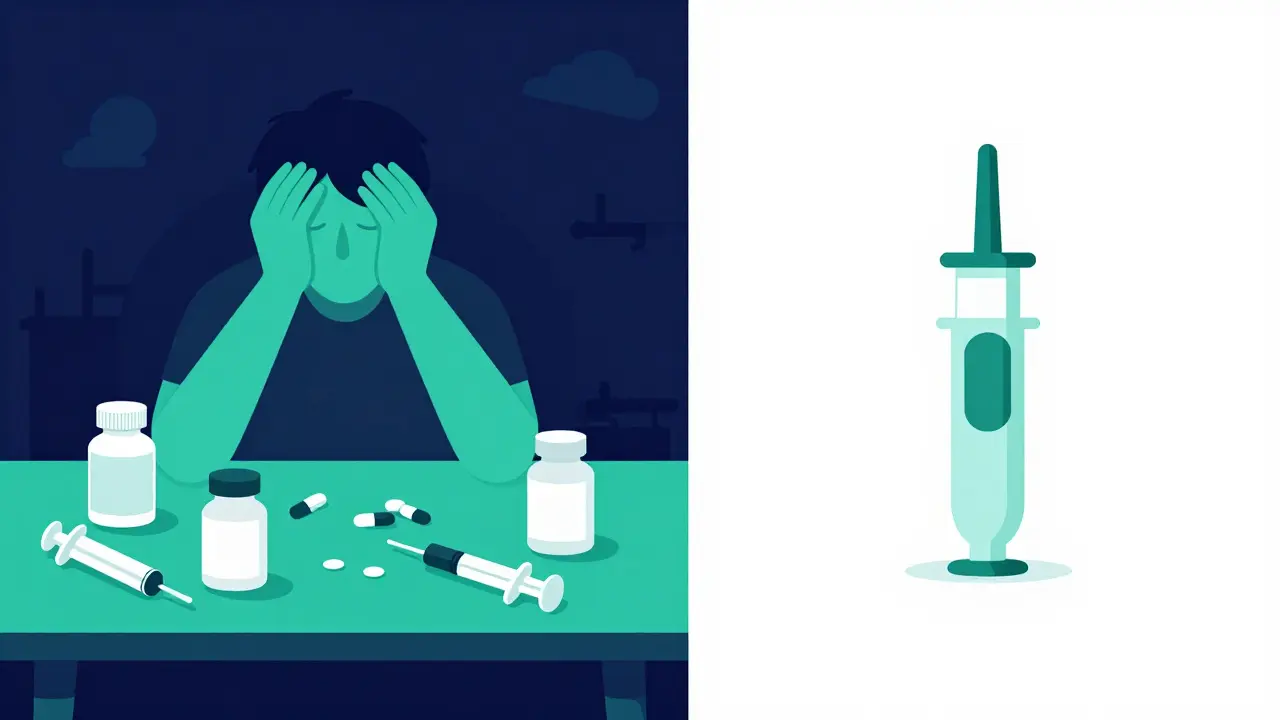
Imagine having to manage five different prescriptions a day, each with a different dosing schedule and a different delivery method. For many people dealing with chronic illnesses, this isn't a hypothetical scenario-it's a daily struggle. When treatment gets complicated, people naturally start skipping doses. This is where generic combination products is a therapeutic approach that integrates multiple drugs or a drug and a medical device into a single delivery system, offered as a bioequivalent, lower-cost version of a brand-name product . By simplifying the process and slashing the price tag, these products tackle the two biggest reasons why patients stop taking their medicine: complexity and cost.
The real-world impact on adherence
Let's be honest: the more steps there are in a medical routine, the more likely someone is to mess it up. Research shows that adherence rates can drop by about 26% just by moving from a once-a-day dose to a twice-a-day schedule. When you add the stress of assembling a separate syringe and vial, the risk of error spikes. This is why integrated systems are a game-changer. Data suggests that switching to combination products can boost medication adherence rates by 15-25% compared to using separate products for the same condition.
Take prefilled insulin pens as a prime example. Instead of the old-school method of drawing liquid from a vial into a syringe-a process prone to measurement errors-these pens integrate the insulin drug with a high-precision delivery mechanism. In real-world communities, patients have reported that this switch reduced their dosing errors from several times a week to almost zero. When the friction of taking a medication is removed, compliance happens naturally.
Breaking the financial barrier to health
We can't talk about compliance without talking about money. Even the most convenient drug is useless if a patient can't afford the refill. FDA research indicates that roughly 23.4% of patients skip doses specifically because of financial constraints. Generic versions of combination products provide a massive relief here, often costing 30-80% less than their brand-name counterparts while offering the same therapeutic benefits.
This price drop isn't just a "nice to have"-it's a clinical necessity. When a patient can actually afford their entire regimen, they are far more likely to stay on it long-term. Interestingly, some studies suggest that patients who start on generic versions of chronic medications actually have adherence rates about 8.7 percentage points higher than those who start on expensive brand-name versions. The peace of mind that comes with affordability directly translates into better health outcomes.
How they actually work: The tech inside
To understand why these products work, you have to look at the engineering. A generic combination product isn't just a pill with two ingredients; it often involves a complex marriage of pharmacology and mechanical engineering. For these to be approved, they must prove bioequivalence-meaning the drug works the same way in the body-while the device part must meet strict performance standards.
| Product Type | Integrated Components | Key Compliance Advantage | Example Metric |
|---|---|---|---|
| Drug-Eluting Stents | Metallic scaffold + medication | Direct site delivery, reducing restenosis | 30-40% risk reduction |
| Prefilled Pens | Insulin + precision dial | Eliminates manual measurement errors | ±5% dose accuracy |
| Transdermal Patches | Drug reservoir + adhesive skin patch | Steady-state delivery, no daily pills | 0.5-1.0 mg/hour delivery |
| Auto-injectors | Drug + spring-loaded needle | Fast, painless, single-step action | 5-15 Newtons activation force |
Whether it's a transdermal patch delivering a steady stream of medication through the skin or an auto-injector that removes the fear of needles, the goal is the same: make the medicine invisible so the patient can focus on living their life.
The "Substitution Trap" and how to avoid it
It's not all smooth sailing, though. One major hurdle is what experts call the substitution trap. Because different manufacturers create different generic versions of the same combination product, a patient might get a different-looking device every time they refill their prescription. This is especially problematic with pulmonary inhalers, where a slight change in the device requires a different breathing technique.
If a patient is switched to a new generic version without being told, they might use the device incorrectly, leading to missed doses or ineffective treatment. About 32% of cases involve some level of confusion during this transition. This is why pharmacist counseling is non-negotiable. When a healthcare provider takes a few minutes to explain why a new generic looks different or how the mechanism has changed, adherence rates can jump by another 17-22%.
The road ahead for drug delivery
The market for these products is exploding, with projections suggesting the global combination product sector will reach over $258 billion by 2030. We're seeing a shift toward "smart" generics-devices that can track when a dose was taken and alert the patient via a smartphone. This adds a digital layer of compliance to the physical convenience of the device.
Recent policy changes, like the Inflation Reduction Act of 2022, are also speeding up the arrival of these generics. By creating incentives for developers to bring more competitive options to market, we're likely to see a 40% increase in approved generic combination products in the coming years. This means more people will have access to the "easy button" of healthcare: medications that are simple to use and affordable to maintain.
Are generic combination products as safe as brand-name ones?
Yes. To get approval, generics must demonstrate bioequivalence to the brand-name version. This means the drug is absorbed by the body at a similar rate and extent. Additionally, the device component must meet the same performance standards for dose accuracy and reliability, ensuring the drug is delivered safely and effectively.
Why do some generics feel different to use than others?
While the medicine inside is the same, the mechanical design of the delivery device (like the click of a pen or the resistance of an inhaler) can vary between manufacturers. This is why it's important to ask your pharmacist if the generic brand has changed during your refill, as you may need a quick refresher on the specific device's technique.
How much money can I actually save by switching to a generic combination product?
Depending on the medication, generic versions typically cost 30% to 80% less than the original brand-name combination product. This significant reduction helps remove the financial barriers that lead many patients to skip doses.
Do combination products actually work better than taking separate pills?
In terms of the chemistry, they are often equivalent. However, in terms of *real-world results*, they often perform better because they improve adherence. When a patient actually takes their medicine as prescribed because it's easier to do so, the clinical outcome is significantly improved.
What should I do if my generic inhaler or pen feels different?
Do not guess the dosage or technique. Contact your pharmacist or doctor immediately for a brief training session. Proper instruction on a new device can take anywhere from 5 to 30 minutes but can prevent serious dosing errors.


Comments (8)