
Imagine walking into your factory floor on a random Tuesday morning. There is no email warning you. There are no last-minute clean-up crews scrambling to hide messy workstations. Instead, three people in suits walk through the front door, flash official badges, and hand you a piece of paper that changes everything. For years, this was the standard reality for domestic manufacturers in the United States. But if you were running a plant overseas, you likely had weeks to prepare. That era is over.
In May 2025, the U.S. Food and Drug Administration (FDA) pulled the rug out from under the global supply chain by expanding its policy of unannounced inspections to foreign manufacturing facilities. This wasn't just a minor tweak to procedure; it was a seismic shift in how the agency ensures the safety of food, medicines, and medical devices entering American homes. If you are involved in manufacturing quality, compliance, or supply chain management, understanding why this happened-and what it means for your operations-is no longer optional. It is survival.
The Core Problem: The "Double Standard" of Oversight
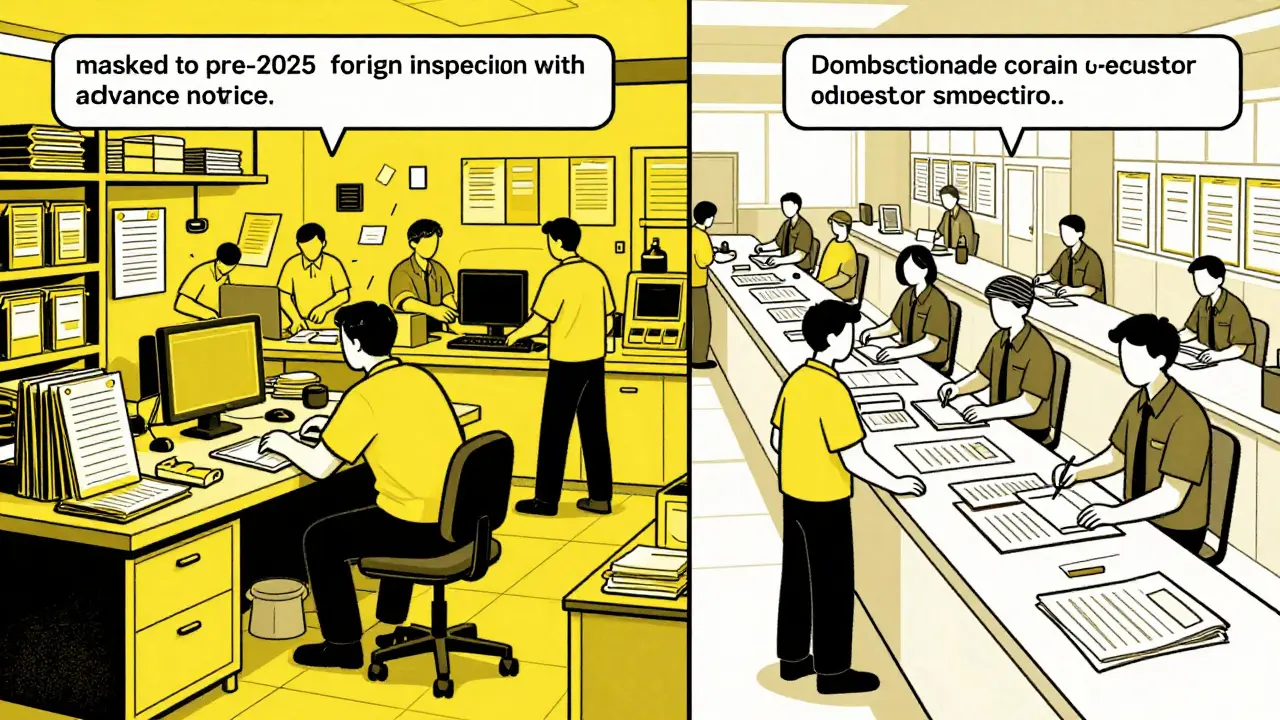
To understand the urgency behind this policy change, you have to look at the data the FDA collected before making the move. For decades, there was a glaring inconsistency in how the agency inspected facilities based on geography. Domestic plants in the U.S. faced surprise visits as the norm. Foreign plants, however, typically received advance notice. This notice was often justified by logistical needs-arranging translators, coordinating travel with local authorities, or ensuring key personnel were present.
But the FDA found that this courtesy came with a heavy price tag. Internal analysis revealed a stark contrast in compliance outcomes. When foreign facilities received advance warning, inspectors still found serious deficiencies more than twice as often as they did during domestic inspections. In some cases, the rate of observations issued via Form FDA 483 (a document listing inspectional observations) exceeded 90% for foreign sites compared to roughly 45% for domestic ones. The agency concluded that the advance notice allowed facilities to temporarily mask chronic issues, falsify records, or conceal violations that would otherwise be visible during routine operations.
This discrepancy created what regulators called a "double standard." It meant that a consumer buying a bottle of pills made in Ohio was subject to different scrutiny levels than someone buying the exact same medication made in India or China. The goal of the new policy is simple: regulatory parity. Every product entering the U.S. market must meet the same high bar of safety, regardless of where it was manufactured.
What Happens During an Unannounced Inspection?
If you think unannounced sounds chaotic, the FDA has a very structured process. It isn't about causing panic; it is about capturing truth. Here is what typically happens when investigators arrive:
- Identification: Investigators identify themselves immediately. They display their credentials to prove they are authorized government agents.
- The Notice: They issue Form FDA 482, officially known as the Notice of Inspection. This is handed to the most responsible individual available at the time, whether that is the plant manager, the quality assurance director, or the shift supervisor.
- Purpose Explanation: They explain the scope of the visit. Are they looking at specific complaints? Is it a routine check of Good Manufacturing Practices (GMP)? Or is it a follow-up to a previous violation?
- Execution: The inspection proceeds. Investigators review Standard Operating Procedures (SOPs), manufacturing records, batch logs, and physical conditions. They may ask to enter sterile manufacturing areas, observe testing labs, or interview staff on the spot.
The duration varies wildly. A small facility with straightforward processes might be inspected in a day. A complex pharmaceutical plant producing multiple drug classes could take weeks. The key factor is that the facility cannot pause production to "fix" things beforehand. The inspection captures the state of operations exactly as they exist in real-time.
Why the Shift in 2025? Political and Public Health Pressures
The timing of this expansion was not accidental. It followed closely after President Donald Trump signed an executive order on May 5, 2025, calling for enhanced inspection of foreign manufacturing facilities. This order specifically targeted the risk-based inspection regime for overseas facilities supplying U.S. medicines. The political context was clear: there was growing concern about the reliability of global supply chains, particularly for active pharmaceutical ingredients (APIs). Approximately 80% of APIs consumed in the United States are manufactured overseas.
FDA Assistant Commissioner for Inspections and Investigations Michael Rogers stated that these inspections provide "real-time evidence and insights that are essential for making fact-based regulatory decisions." The agency wanted to expose "bad actors"-those who cut corners, falsify data, or ignore safety protocols-before those products reached American patients. By removing the ability to prepare for the inspection, the FDA aims to strip away the layer of deception that can occur when companies know they are being watched.
Impact on Global Supply Chains
The ripple effects of this policy are massive. The FDA conducts approximately 3,000 foreign inspections annually across more than 90 countries. Prior to 2025, many of these were coordinated with local Competent Authorities-the national regulatory bodies responsible for food and drug safety in the host country. Historically, the FDA would share itineraries and sometimes invite local officials to observe.
Under the new unannounced model, this coordination becomes tricky. Lawyers and industry experts note that while the FDA has not explicitly banned all communication with foreign authorities, the spirit of the policy requires minimizing prior notification to the manufacturer itself. This creates diplomatic friction. How do you ensure a translator is present without alerting the factory? How do you secure visas for inspectors without giving the company a heads-up? These are operational puzzles that both the FDA and manufacturers are currently solving.
For manufacturers, the impact is immediate. You can no longer rely on "inspection season" preparation. Your Quality Management System (QMS) must be robust enough to withstand scrutiny at any second. Legacy systems that require manual patching or "duct-taping" together documentation will fail under this pressure. Companies are now investing heavily in digital QMS tools that maintain continuous, immutable records.
How Manufacturers Can Prepare for the Unexpected
You cannot predict when the FDA will knock. But you can control how ready you are when they do. Preparation for unannounced inspections is not about hiding flaws; it is about demonstrating consistent compliance. Here is a practical checklist for maintaining readiness:
- Develop a Response Plan: Designate specific personnel to handle the initial contact. Who greets the inspectors? Who provides access to records? Who handles logistics? This plan should be drilled regularly.
- Maintain Real-Time Documentation: Ensure that batch records, SOPs, and deviation reports are up-to-date daily. Do not wait for month-end close-outs. If an inspector asks for the record from yesterday, it should be complete and accurate.
- Conduct Mock Inspections: Simulate surprise visits internally. Have auditors walk the floor without warning. Test your team's ability to retrieve documents quickly and answer questions confidently.
- Train All Staff: Compliance is not just the QA department's job. Line workers should know basic GMP principles and understand the importance of accurate record-keeping. They may be interviewed during an inspection.
- Address Language Barriers Proactively: For foreign facilities, have certified translators on standby or available remotely. Do not let language delays hinder the inspection process.
The mindset shift is critical. Stop viewing inspections as events to survive. Start viewing them as validations of your daily discipline. If your facility is compliant today, tomorrow, and next week, an unannounced visit is just another Tuesday.
| Feature | Domestic Facilities (U.S.) | Foreign Facilities (Pre-2025) | Foreign Facilities (Post-2025) |
|---|---|---|---|
| Notice Period | None (Unannounced) | Weeks (Announced) | None (Unannounced) |
| Primary Goal | Routine Compliance Check | Logistical Coordination | Real-Time Evidence Gathering |
| Deficiency Rate | ~45% | >90% | Targeting Reduction to Match Domestic |
| Translator Arrangement | N/A | Arranged in Advance | On-Demand / Standby Required |
| Regulatory Parity | High | Low | High |
The Future of Regulatory Oversight
This policy marks a "new era" in FDA enforcement, according to agency leadership. It signals that the days of leniency for geographic distance are over. As global supply chains become more complex, the demand for transparency and accountability will only increase. Manufacturers who adapt quickly-who build cultures of continuous compliance rather than periodic preparation-will thrive. Those who cling to old habits will find themselves facing stricter regulatory actions, including import bans, warning letters, and criminal referrals.
The bottom line is clear: the FDA wants to see your operation as it truly is, not as you want it to appear. Embrace the surprise. Build the resilience. Protect the public health.
Why did the FDA expand unannounced inspections to foreign facilities in 2025?
The FDA expanded unannounced inspections to address a "double standard" where foreign facilities received advance notice, allowing them to mask deficiencies. Data showed that foreign sites with advance notice had significantly higher rates of serious violations compared to domestic sites. The expansion aims to ensure regulatory parity and protect public health by obtaining real-time evidence of compliance.
What is Form FDA 483?
Form FDA 483 is a formal document issued by FDA investigators at the conclusion of an inspection. It lists specific observations of violations or deviations from regulations such as Current Good Manufacturing Practice (CGMP). Receiving a Form 483 indicates that the facility failed to meet certain standards and requires corrective action.
How should manufacturers prepare for unannounced inspections?
Manufacturers should develop a comprehensive response plan, designate trained personnel to handle inspectors, maintain real-time and accurate documentation, conduct regular mock inspections, and ensure all staff are trained on GMP principles. The goal is to demonstrate consistent compliance rather than preparing specifically for the visit.
Does the FDA still coordinate with foreign regulatory authorities?
While the FDA has historically coordinated with foreign Competent Authorities, the new unannounced policy complicates this practice. The agency has not explicitly banned all communication but emphasizes minimizing prior notification to the manufacturer. This creates challenges for logistics like translation and visa processing, which are now being addressed through alternative mechanisms.
What happens if a facility denies an unannounced inspection?
The FDA is authorized to take regulatory action against firms that delay, deny, or limit an inspection. Denial can lead to severe consequences, including import alerts, suspension of registration, and potential criminal charges. Cooperation is mandatory for facilities wishing to continue selling products in the U.S. market.